


Page 146 - Airpower in 20th Century - Doctrines and Employment
P. 146
146                            airpower in 20  Century doCtrines and employment - national experienCes
                                               tH


               gets. This operation also includes attacking tanks and armoured vehicles either
               on their way to the front or in retreat, with the aim of paralyzing the enemy in the
               battle zone;
            d.  Strategic bombing. Attacking bridges, fuel dumps, ports, military installations,
               command posts etc., behind enemy lines and in enemy territory;
            e.  Transport. Delivery of special forces behind enemy lines;
            f.  Supply. Carrying essential supplies to ground forces – fuel, spare parts, ammuni-
               tion, food etc;
            g.  Photographic reconnaissance;
            h.  Evacuation and transport of wounded to medical centers;
            i.  Patrols in the battle area - for purposes of up to date intelligence and support of
               ground troops;
            j.  Transporting war materials from abroad – essential in time of war.
               In accordance with these objectives, the air force developed its unique concept
                                          based on the versatility of the aircraft, adaptability
                                          of the air crew to carry out different types of mis-
                                          sions, and development of the principle of “Cen-
                                          tral Command”.
                                             This  concept  became  the  underlying  founda-
                                          tion of the air force’s policy and proved itself in
                                          all the wars and battles in which the IAF partici-
                                          pated.


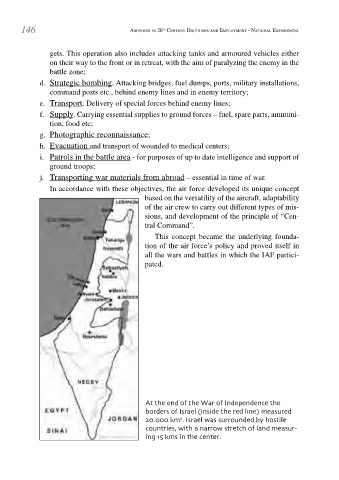
                                          At the end of the War of Independence the
                                          borders of Israel (inside the red line) measured
                                                    2
                                          20.000 km . Israel was surrounded by hostile
                                          countries, with a narrow stretch of land measur-
                                          ing 15 kms in the center.

