


Page 223 - Airpower in 20th Century - Doctrines and Employment
P. 223
a Century of military aviation in tHe netHerlands, 1911-2011               223


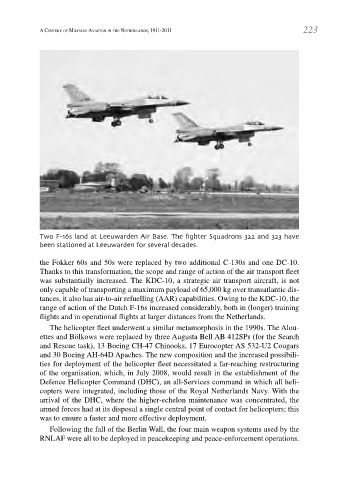
            Two F-16s land at Leeuwarden Air Base. The fighter Squadrons 322 and 323 have
            been stationed at Leeuwarden for several decades.

            the Fokker 60s and 50s were replaced by two additional C-130s and one DC-10.
            Thanks to this transformation, the scope and range of action of the air transport fleet
            was substantially increased. The KDC-10, a strategic air transport aircraft, is not
            only capable of transporting a maximum payload of 65,000 kg over transatlantic dis-
            tances, it also has air-to-air refuelling (AAR) capabilities. Owing to the KDC-10, the
            range of action of the Dutch F-16s increased considerably, both in (longer) training
            flights and in operational flights at larger distances from the Netherlands.
               The helicopter fleet underwent a similar metamorphosis in the 1990s. The Alou-
            ettes and Bölkows were replaced by three Augusta Bell AB 412SPs (for the Search
            and Rescue task), 13 Boeing CH-47 Chinooks, 17 Eurocopter AS 532-U2 Cougars
            and 30 Boeing AH-64D Apaches. The new composition and the increased possibili-
            ties for deployment of the helicopter fleet necessitated a far-reaching restructuring
            of the organisation, which, in July 2008, would result in the establishment of the
            Defence Helicopter Command (DHC), an all-Services command in which all heli-
            copters were integrated, including those of the Royal Netherlands Navy. With the
            arrival of the DHC, where the higher-echelon maintenance was concentrated, the
            armed forces had at its disposal a single central point of contact for helicopters; this
            was to ensure a faster and more effective deployment.
               Following the fall of the Berlin Wall, the four main weapon systems used by the
            RNLAF were all to be deployed in peacekeeping and peace-enforcement operations.

