


Page 327 - The Secret War in the Italian front in WWI (1915-1918)
P. 327
CHAPTER FOURTEEN


                  Ronge testified the resistance of the Grey Tables to any decoding attempt, knowing them only by
                  the word ‘grey’ .
                                28
                  The S.I. and D systems shared at least two other characteristics. In both cases, they were second
                  editions largely disseminated and employed outside the Army units for which they were originally
                  conceived.
                  As far as the Service, T1, SC, and SA are concerned, these were never mentioned by Austrian
                  sources, except for the SA in the circumstances already shown .
                                                                           29
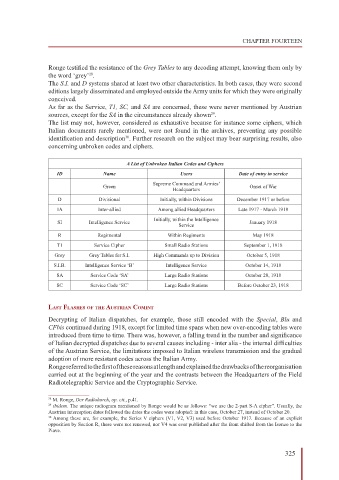
                  The list may not, however, considered as exhaustive because for instance some ciphers, which
                  Italian documents rarely mentioned,  were not found in the archives, preventing any possible
                  identification and description . Further research on the subject may bear surprising results, also
                                             30
                  concerning unbroken codes and ciphers.


                                             A List of Unbroken Italian Codes and Ciphers
                     ID              Name                       Users                Date of entry in service

                                                       Supreme Command and Armies’
                                     Green                                               Onset of War
                                                              Headquarters
                     D              Divisional           Initially, within Divisions  December 1917 or before
                     IA            Inter-allied          Among allied Headquarters   Late 1917 - March 1918
                                                       Initially, within the Intelligence
                     SI         Intelligence Service                                     January 1918
                                                                Service
                     R             Regimental               Within Regiments              May 1918
                     T1           Service Cipher           Small Radio Stations        September 1, 1918
                    Grey        Grey Tables for S.I.   High Commands up to Division     October 5, 1918
                    S.I.B.     Intelligence Service ‘B’    Intelligence Service        October 14, 1918

                     SA          Service Code ‘SA’         Large Radio Stations        October 20, 1918
                     SC          Service Code ‘SC’         Large Radio Stations      Before October 23, 1918


                  lasT flashes of The ausTrIan coMInT
                  Decrypting  of Italian  dispatches,  for example,  those still  encoded  with the  Special,  Blu and
                  CFbis continued during 1918, except for limited time spans when new over-encoding tables were
                  introduced from time to time. There was, however, a falling trend in the number and significance
                  of Italian decrypted dispatches due to several causes including - inter alia - the internal difficulties
                  of the Austrian Service, the limitations imposed to Italian wireless transmission and the gradual
                  adoption of more resistant codes across the Italian Army.
                  Ronge referred to the first of these reasons at length and explained the drawbacks of the reorganisation
                  carried out at the beginning of the year and the contrasts between the Headquarters of the Field
                  Radiotelegraphic Service and the Cryptographic Service.


                  28  M. Ronge, Der Radiohorch, op. cit., p.41.
                  29  ibidem. The unique radiogram mentioned by Ronge would be as follows: “we use the 2-part S-A cipher”. Usually, the
                  Austrian interception dates followed the dates the codes were adopted: in this case, October 27, instead of October 20.
                  30  Among these are, for example, the Series V ciphers (V1, V2, V3) used before October 1917. Because of an explicit
                  opposition by Section R, these were not renewed, nor V4 was ever published after the front shifted from the Isonzo to the
                  Piave.


                                                                                                     325

