


Page 215 - Airpower in 20th Century - Doctrines and Employment
P. 215
a Century of military aviation in tHe netHerlands, 1911-2011               215


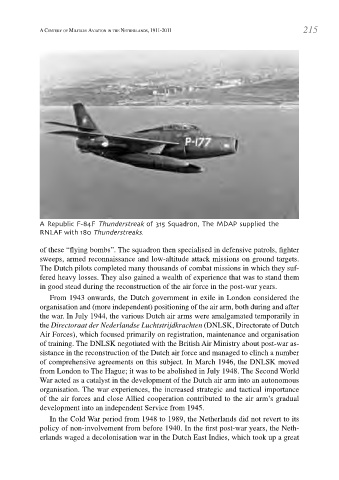
            A Republic F-84F Thunderstreak of 315 Squadron, The MDAP supplied the
            RNLAF with 180 Thunderstreaks.


            of these “flying bombs”. The squadron then specialised in defensive patrols, fighter
            sweeps, armed reconnaissance and low-altitude attack missions on ground targets.
            The Dutch pilots completed many thousands of combat missions in which they suf-
            fered heavy losses. They also gained a wealth of experience that was to stand them
            in good stead during the reconstruction of the air force in the post-war years.
               From 1943 onwards, the Dutch government in exile in London considered the
            organisation and (more independent) positioning of the air arm, both during and after
            the war. In July 1944, the various Dutch air arms were amalgamated temporarily in
            the Directoraat der Nederlandse Luchtstrijdkrachten (DNLSK, Directorate of Dutch
            Air Forces), which focused primarily on registration, maintenance and organisation
            of training. The DNLSK negotiated with the British Air Ministry about post-war as-
            sistance in the reconstruction of the Dutch air force and managed to clinch a number
            of comprehensive agreements on this subject. In March 1946, the DNLSK moved
            from London to The Hague; it was to be abolished in July 1948. The Second World
            War acted as a catalyst in the development of the Dutch air arm into an autonomous
            organisation. The war experiences, the increased strategic and tactical importance
            of the air forces and close Allied cooperation contributed to the air arm’s gradual
            development into an independent Service from 1945.
               In the Cold War period from 1948 to 1989, the Netherlands did not revert to its
            policy of non-involvement from before 1940. In the first post-war years, the Neth-
            erlands waged a decolonisation war in the Dutch East Indies, which took up a great

