


Page 20 - The Secret War in the Italian front in WWI (1915-1918)
P. 20
THE SECRET WAR ON THE ITALIAN FRONT IN WWI (1915 – 1918)


              However, in evaluating  Ronge’s book, one should not ignore Aldo  Valori’s general  remarks
              contained in the foreword to the Italian translation of the volume. Valori points out that “Ronge
              wrote his book several years after the war and had the opportunity to consult all the Italian stories
              about the conflict” contained in publications often mentioned by the Author. Valori concludes that
              “therefore, at least a part of his science could be a hindsight science” .
                                                                             5

              fInally, an answer

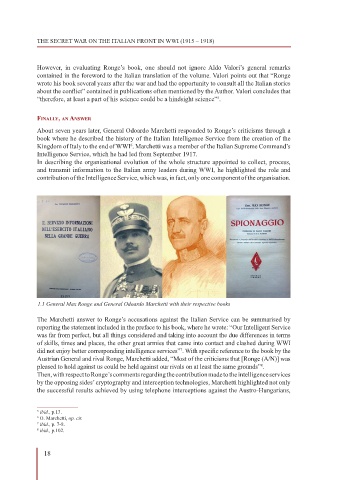
              About seven years later, General Odoardo Marchetti responded to Ronge’s criticisms through a
              book where he described the history of the Italian Intelligence Service from the creation of the
              Kingdom of Italy to the end of WWI . Marchetti was a member of the Italian Supreme Command’s
                                               6
              Intelligence Service, which he had led from September 1917.
              In describing the organisational evolution of the whole structure appointed to collect, process,
              and transmit information to the Italian army leaders during WWI, he highlighted the role and
              contribution of the Intelligence Service, which was, in fact, only one component of the organisation.


              1.1 General Max Ronge and General Odoardo Marchetti with their respective books

              The Marchetti answer to Ronge’s accusations against the Italian Service can be summarised by
              reporting the statement included in the preface to his book, where he wrote: “Our Intelligent Service
              was far from perfect, but all things considered and taking into account the due differences in terms
              of skills, times and places, the other great armies that came into contact and clashed during WWI
              did not enjoy better corresponding intelligence services” . With specific reference to the book by the
                                                                7
              Austrian General and rival Ronge, Marchetti added, “Most of the criticisms that [Ronge (A/N)] was
              pleased to hold against us could be held against our rivals on at least the same grounds” .
                                                                                             8
              Then, with respect to Ronge’s comments regarding the contribution made to the intelligence services
              by the opposing sides’ cryptography and interception technologies, Marchetti highlighted not only
              the successful results achieved by using telephone interceptions against the Austro-Hungarians,


              5  ibid., p.13.
              6  O. Marchetti, op. cit.
              7  ibid., p. 7-8.
              8  ibid., p.102.


                18

