


Page 25 - The Secret War in the Italian front in WWI (1915-1918)
P. 25
CHAPTER ONE


                  the Manual 1947 edition, Kahn restated his conviction that the Sacco book was still “the best one
                  volume work, on the technical aspects of cryptology. Sacco was thus a major figure in the pantheon
                  of cryptology” .
                               24
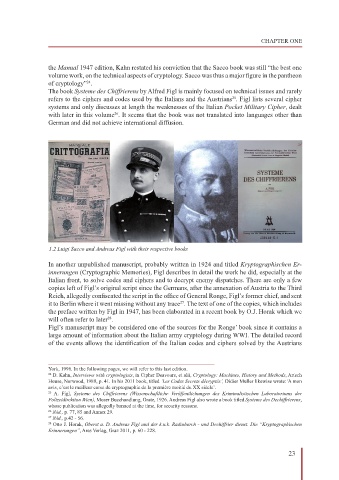
                  The book Systeme des Chiffrierens by Alfred Figl is mainly focused on technical issues and rarely
                  refers to the ciphers and codes used by the Italians and the Austrians . Figl lists several cipher
                                                                                   25
                  systems and only discusses at length the weaknesses of the Italian Pocket Military Cipher, dealt
                  with later in this volume . It seems that the book was not translated into languages other than
                                         26
                  German and did not achieve international diffusion.


                  1.2 Luigi Sacco and Andreas Figl with their respective books

                  In another unpublished manuscript, probably written in 1924 and titled Kryptographischen Er-
                  innerungen (Cryptographic Memories), Figl describes in detail the work he did, especially at the
                  Italian front, to solve codes and ciphers and to decrypt enemy dispatches. There are only a few
                  copies left of Figl’s original script since the Germans, after the annexation of Austria to the Third
                  Reich, allegedly confiscated the script in the office of General Ronge, Figl’s former chief, and sent
                  it to Berlin where it went missing without any trace . The text of one of the copies, which includes
                                                                27
                  the preface written by Figl in 1947, has been elaborated in a recent book by O.J. Horak which we
                  will often refer to later .
                                       28
                  Figl’s manuscript may be considered one of the sources for the Ronge’ book since it contains a
                  large amount of information about the Italian army cryptology during WWI. The detailed record
                  of the events allows the identification of the Italian codes and ciphers solved by the Austrians


                  York, 1996. In the following pages, we will refer to this last edition.
                  24  D. Kahn, Interviews with cryptologists, in Cipher Deavours, et alii, Cryptology: Machines, History and Methods, Artech
                  House, Norwood, 1989, p. 41. In his 2011 book, titled ‘Les Codes Secrets décryptés’, Didier Muller likewise wrote:‘A mon
                  avis, c’est le meilleur corse de cryptographie de la première moitié du XX siècle’.
                  25  A.  Figl,  Systeme  des  Chiffrierens  (Wissenschaftliche  Veröffentlichungen  des  Kriminalistischen  Laboratoriums  der
                  Polizeidirektion Wien), Moser Bucchandlung, Gratz, 1926. Andreas Figl also wrote a book titled Systeme des Dechiffrierens,
                  whose publication was allegedly banned at the time, for security reasons.
                  26  ibid., p. 77, 85 and Annex 29.
                  27  ibid., p.42 - 56.
                  28  Otto J. Horak, Oberst a. D. Andreas Figl und der k.u.k. Radiohorch - und Dechiffrier dienst. Die “Kryptographischen
                  Erinnerungen”, Ares Verlag, Graz 2011, p. 60 - 228.


                                                                                                      23

