


Page 210 - The Secret War in the Italian front in WWI (1915-1918)
P. 210
THE SECRET WAR ON THE ITALIAN FRONT IN WWI (1915 – 1918)


              recovery  operations . However, the
                                 14
              KOD was still used by submarines
              even after September 1916 .
                                       15
              To understand the structure the KOD
              series, reference can be made to the
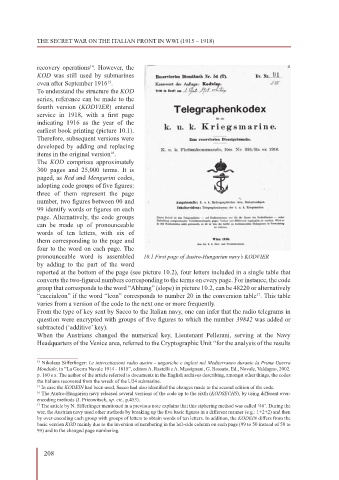
              fourth version (KODVIER) entered
              service  in  1918,  with  a  first  page
              indicating  1916 as the  year of the
              earliest book printing (picture 10.1).
              Therefore, subsequent versions were
              developed  by adding  and  replacing
              items in the original version .
                                        16
              The  KOD comprises  approximately
              300 pages and 25,000 terms. It is
              paged, as Red and Mengarini codes,
              adopting code groups of five figures:
              three  of them represent  the page
              number, two figures between 00 and
              99 identify words or figures on each
              page. Alternatively, the code groups
              can  be made  up of pronounceable
              words of ten letters,  with six of
              them corresponding to the page and
              four to the word on each page. The
              pronounceable  word is assembled     10.1 First page of Austro-Hungarian navy’s KODVIER
              by adding to the part of the word
              reported at the bottom of the page (see picture 10.2), four letters included in a single table that
              converts the two-figured numbers corresponding to the terms on every page. For instance, the code
              group that corresponds to the word “Abhang” (slope) in picture 10.2, can be 48220 or alternatively
              “caccialeon” if the word “leon” corresponds to number 20 in the conversion table . This table
                                                                                           17
              varies from a version of the code to the next one or more frequently.
              From the type of key sent by Sacco to the Italian navy, one can infer that the radio telegrams in
              question were encrypted with groups of five figures to which the number 39842 was added or
              subtracted (‘additive’ key).
              When the  Austrians changed  the numerical  key, Lieutenant  Pellerani,  serving at  the Navy
              Headquarters of the Venice area, referred to the Cryptographic Unit “for the analysis of the results


              14  Nikolaus Sifferlinger: Le intercettazioni radio austro - ungariche e inglesi nel Mediterraneo durante la Prima Guerra
              Mondiale, in “La Guerra Navale 1914 - 1818”, editors A. Rastelli e A. Massignani, G. Rossato, Ed., Novale, Valdagno, 2002.
              p. 160 e s. The author of the article referred to documents in the English archives describing, amongst other things, the codes
              the Italians recovered from the wreck of the U24 submarine.
              15  In case the KODEIN had been used, Sacco had also identified the changes made to the second edition of the code.
              16  The Austro-Hungarian navy released several versions of the code up to the sixth (KODSECHS), by using different over-
              encoding methods (J. Pricowitsch, op. cit., p.453).
              17  The article by N. Sifferlinger mentioned in a previous note explains that this ciphering method was called ‘46’. During the
              war, the Austrian navy used other methods by breaking up the five basic figures in a different manner (e.g.: 1+2+2) and then
              by over-encoding each group with groups of letters to obtain words of ten letters. In addition, the KODEIN differs from the
              basic version KOD mainly due to the inversion of numbering in the left-side column on each page (99 to 50 instead of 50 to
              99) and to the changed page numbering.


                208

