


Page 213 - The Secret War in the Italian front in WWI (1915-1918)
P. 213
CHAPTER TEN


                  Until the end of 1916, the Cryptographic
                  Unit sent to the Italian  navy at least  20
                  decrypted dispatches of this kind and on
                  one occasion, it transmitted the ‘related
                  encoding  alphabet’,  which was evidently
                  well known . Very often, telegrams were
                             27
                  also  distributed  to  the  Ministry  of  War,
                  to the Ministry of Foreign Affairs and to
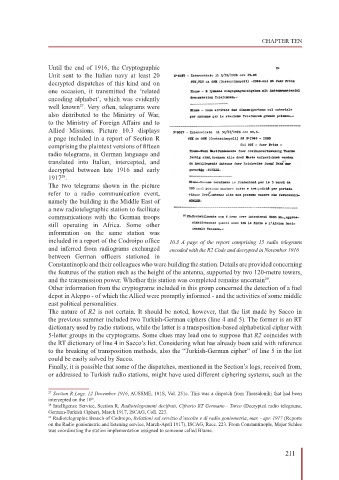
                  Allied Missions.  Picture 10.3 displays
                  a page included in a report of Section R
                  comprising the plaintext versions of fifteen
                  radio telegrams, in German language and
                  translated  into Italian,  intercepted,  and
                  decrypted  between  late  1916 and  early
                  1917 .
                       28
                  The  two  telegrams  shown in  the  picture
                  refer  to a  radio  communication  event,
                  namely the building in the Middle East of
                  a new radiotelegraphic station to facilitate
                  communications  with  the  German  troops
                  still operating in  Africa. Some other
                  information  on the  same  station  was
                  included in a report of the Codroipo office   10.3  A  page  of  the  report  comprising  15  radio  telegrams
                  and inferred from radiograms exchanged     encoded with the R2 Code and decrypted in November 1916
                  between  German  officers  stationed  in
                  Constantinople and their colleagues who were building the station. Details are provided concerning
                  the features of the station such as the height of the antenna, supported by two 120-metre towers,
                  and the transmission power. Whether this station was completed remains uncertain .
                                                                                              29
                  Other information from the cryptograms included in this group concerned the detection of a fuel
                  depot in Aleppo - of which the Allied were promptly informed - and the activities of some middle
                  east political personalities.
                  The nature of R2 is not certain. It should be noted, however, that the list made by Sacco in
                  the previous summer included two Turkish-German ciphers (line 4 and 5). The former is an RT
                  dictionary used by radio stations, while the latter is a transposition-based alphabetical cipher with
                  5-letter groups in the cryptograms. Some clues may lead one to suppose that R2 coincides with
                  the RT dictionary of line 4 in Sacco’s list. Considering what has already been said with reference
                  to the breaking of transposition methods, also the “Turkish-German cipher” of line 5 in the list
                  could be easily solved by Sacco.
                  Finally, it is possible that some of the dispatches, mentioned in the Section’s logs, received from,
                  or addressed to Turkish radio stations, might have used different ciphering systems, such as the


                  27  Section R Logs, 12 December 1916, AUSSME, 101S, Vol. 251c. This was a dispatch from Thessaloniki that had been
                                 th
                  intercepted on the 10 .
                  28  Intelligence Service, Section R, Radiotelegrammi decifrati, Cifrario RT Germano - Turco (Decrypted radio telegrams,
                  German-Turkish Cipher), March 1917, ISCAG, Coll. 223.
                  29  Radiotelegraphic Branch of Codroipo, Relazioni sul servizio d’ascolto e di radio goniometria, mar. - apr. 1917 (Reports
                  on the Radio goniometric and listening service, March-April 1917), ISCAG, Racc. 223. From Constantinople, Major Schlee
                  was coordinating the station implementation assigned to someone called Blume.


                                                                                                     211

