


Page 218 - The Secret War in the Italian front in WWI (1915-1918)
P. 218
THE SECRET WAR ON THE ITALIAN FRONT IN WWI (1915 – 1918)


              roTaTIng grIlles
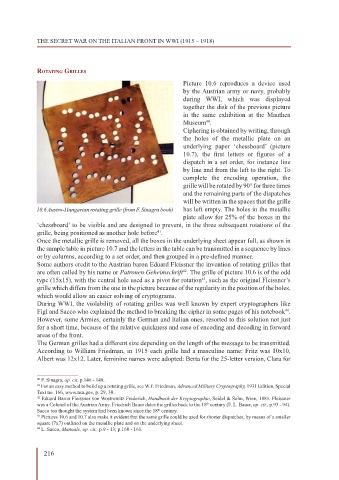
                                                                 Picture 10.6 reproduces a device used
                                                                 by the Austrian army or navy, probably
                                                                 during  WWI, which was displayed
                                                                 together the disk of the previous picture
                                                                 in the same exhibition  at the Mauthen
                                                                 Museum .
                                                                         40
                                                                 Ciphering is obtained by writing, through
                                                                 the  holes of the  metallic  plate  on an
                                                                 underlying  paper  ‘chessboard’ (picture
                                                                 10.7),  the  first  letters  or  figures  of  a
                                                                 dispatch in a set order, for instance line
                                                                 by line and from the left to the right. To
                                                                 complete  the  encoding  operation,  the
                                                                 grille will be rotated by 90° for three times
                                                                 and the remaining parts of the dispatches
                                                                 will be written in the spaces that the grille
              10.6 Austro-Hungarian rotating grille (from F. Sinagra book)  has left empty. The holes in the metallic
                                                                 plate allow for 25% of the boxes in the
              ‘chessboard’ to be visible and are designed to prevent, in the three subsequent rotations of the
              grille, being positioned as another hole before .
                                                        41
              Once the metallic grille is removed, all the boxes in the underlying sheet appear full, as shown in
              the sample table in picture 10.7 and the letters in the table can be transmitted in a sequence by lines
              or by columns, according to a set order, and then grouped in a pre-defined manner.
              Some authors credit to the Austrian baron Eduard Fleissner the invention of rotating grilles that
              are often called by his name or Patronen Geheimschrift . The grille of picture 10.6 is of the odd
                                                                 42
              type (15x15), with the central hole used as a pivot for rotation , such as the original Fleissner’s
                                                                        43
              grille which differs from the one in the picture because of the regularity in the position of the holes,
              which would allow an easier solving of cryptograms.
              During WWI, the violability of rotating grilles was well known by expert cryptographers like
              Figl and Sacco who explained the method to breaking the cipher in some pages of his notebook .
                                                                                                     44
              However, some Armies, certainly the German and Italian ones, resorted to this solution not just
              for a short time, because of the relative quickness and ease of encoding and decoding in forward
              areas of the front.
              The German grilles had a different size depending on the length of the message to be transmitted.
              According to William Friedman, in 1915 each grille had a masculine name: Fritz was 10x10,
              Albert was 12x12. Later, feminine names were adopted: Berta for the 25-letter version, Clara for


              40  F. Sinagra, op. cit. p.146 - 148.
              41  For an easy method to build up a rotating grille, see W.F. Friedman, Advanced Military Cryptography, 1931 Edition, Special
              Text no. 166, www.nsa.gov, p. 29, 30.
              42  Eduard Baron Fleissner von Wostrowitz Frederich, Handbuch der Kryptographie, Seidel & Sohn, Wien, 1881. Fleissner
              was a Colonel of the Austrian Army. Friedrich Bauer dates the grilles back to the 18  century (F. L. Bauer, op. cit., p.93 - 94).
                                                                          th
              Sacco too thought the system had been known since the 18  century.
                                                        th
              43  Pictures 10.6 and 10.7 also make it evident that the same grille could be used for shorter dispatches, by means of a smaller
              square (7x7) outlined on the metallic plate and on the underlying sheet.
              44  L. Sacco, Manuale, op. cit., p.9 - 13; p.160 - 161.


                216

