


Page 219 - The Secret War in the Italian front in WWI (1915-1918)
P. 219
CHAPTER TEN


                  the 36-letter version, Dora for 49 and so
                  on .
                    45
                  Sacco’s  notebook shows  that rotating
                  grilles were most likely used also by the
                  Austrian-Hungarian  navy.  The fact  that
                  the  Austrian army did not employ  the
                  grilles during WWI is seemingly proven
                  by a sentence in one of Ronge’s letters,
                  where he rejected the suggestion to adopt
                  rotating grilles by declaring that they had
                  never been used before . However, the
                                        46
                  same  source quotes  a report  of August
                  1918 by the 48  Division of the Austrian
                                th
                  infantry clearly indicating that method as
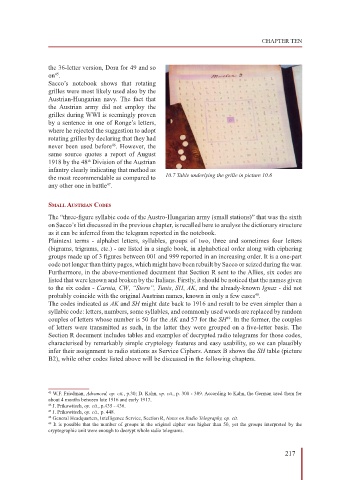
                  the most recommendable as compared to    10.7 Table underlying the grille in picture 10.6
                  any other one in battle .
                                       47

                  sMall ausTrIan codes

                  The “three-figure syllabic code of the Austro-Hungarian army (small stations)” that was the sixth
                  on Sacco’s list discussed in the previous chapter, is recalled here to analyse the dictionary structure
                  as it can be inferred from the telegram reported in the notebook.
                  Plaintext  terms - alphabet  letters,  syllables,  groups of two, three  and  sometimes  four letters
                  (bigrams, trigrams, etc.) - are listed in a single book, in alphabetical order along with ciphering
                  groups made up of 3 figures between 001 and 999 reported in an increasing order. It is a one-part
                  code not longer than thirty pages, which might have been rebuilt by Sacco or seized during the war.
                  Furthermore, in the above-mentioned document that Section R sent to the Allies, six codes are
                  listed that were known and broken by the Italians. Firstly, it should be noticed that the names given
                  to the six codes - Carnia, CW, “Stern”, Tunis, SH, AK, and the already-known Ignaz - did not
                  probably coincide with the original Austrian names, known in only a few cases .
                                                                                           48
                  The codes indicated as AK and SH might date back to 1916 and result to be even simpler than a
                  syllabic code: letters, numbers, some syllables, and commonly used words are replaced by random
                  couples of letters whose number is 50 for the AK and 57 for the SH . In the former, the couples
                                                                                 49
                  of letters were transmitted as such, in the latter they were grouped on a five-letter basis. The
                  Section R document includes tables and examples of decrypted radio telegrams for those codes,
                  characterised by remarkably simple cryptology features and easy usability, so we can plausibly
                  infer their assignment to radio stations as Service Ciphers. Annex B shows the SH table (picture
                  B2), while other codes listed above will be discussed in the following chapters.


                  45  W.F. Friedman, Advanced, op. cit., p.30; D. Kahn, op. cit., p. 308 - 309. According to Kahn, the German used them for
                  about 4 months between late 1916 and early 1917.
                  46  J. Prikowitsch, op. cit., p.435 - 436.
                  47  J. Prikowitsch, op. cit., p. 448.
                  48  General Headquarters, Intelligence Service, Section R, Notes on Radio Telegraphy, op. cit.
                  49  It is possible that the number of groups in the original cipher was higher than 50, yet the groups interpreted by the
                  cryptographic unit were enough to decrypt whole radio telegrams.


                                                                                                     217

