


Page 220 - The Secret War in the Italian front in WWI (1915-1918)
P. 220
THE SECRET WAR ON THE ITALIAN FRONT IN WWI (1915 – 1918)


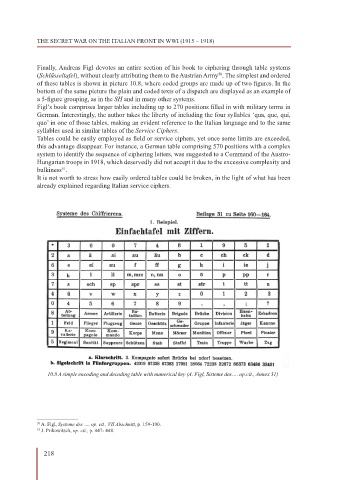
              Finally, Andreas Figl devotes an entire section of his book to ciphering through table systems
              (Schlűsseltafel), without clearly attributing them to the Austrian Army . The simplest and ordered
                                                                              50
              of these tables is shown in picture 10.8, where coded groups are made up of two figures. In the
              bottom of the same picture the plain and coded texts of a dispatch are displayed as an example of
              a 5-figure grouping, as in the SH and in many other systems.
              Figl’s book comprises larger tables including up to 270 positions filled in with military terms in
              German. Interestingly, the author takes the liberty of including the four syllables ‘qua, que, qui,
              quo’ in one of those tables, making an evident reference to the Italian language and to the same
              syllables used in similar tables of the Service Ciphers.
              Tables could be easily employed as field or service ciphers, yet once some limits are exceeded,
              this advantage disappear. For instance, a German table comprising 570 positions with a complex
              system to identify the sequence of ciphering letters, was suggested to a Command of the Austro-
              Hungarian troops in 1918, which deservedly did not accept it due to the excessive complexity and
              bulkiness .
                       51
              It is not worth to stress how easily ordered tables could be broken, in the light of what has been
              already explained regarding Italian service ciphers.


                  10.8 A simple encoding and decoding table with numerical key (A. Figl, Sisteme des…. op.cit., Annex 31)


              50  A. Figl, Systeme des …, op. cit., VII Abschnitt, p. 159-190.
              51  J. Prikowitsch, op. cit., p. 447- 448.


                218

