


Page 225 - The Secret War in the Italian front in WWI (1915-1918)
P. 225
CHAPTER TEN


                  rules and abbreviations used by the enemy, etc. Listening activity became easier also thanks to the
                  adoption of completely stand-alone receivers, independent from transmitters. In September 1916,
                  for the first time, the Austrian army commissioned ten receivers for interception only, delivered
                  the following year, while the Italians had similar receivers in Codroipo and elsewhere, for about
                  one year already .
                                 65

                  ITalIan cIPhers’ ProlIferaTIon

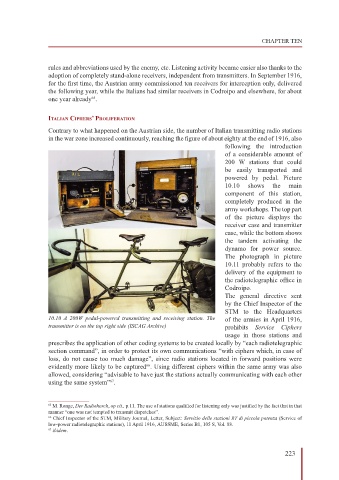
                  Contrary to what happened on the Austrian side, the number of Italian transmitting radio stations
                  in the war zone increased continuously, reaching the figure of about eighty at the end of 1916, also
                                                                                following  the introduction
                                                                                of a considerable amount of
                                                                                200  W stations that  could
                                                                                be easily  transported and
                                                                                powered  by pedal.  Picture
                                                                                10.10   shows    the  main
                                                                                component of this station,
                                                                                completely  produced in the
                                                                                army workshops. The top part
                                                                                of the picture displays the
                                                                                receiver case and transmitter
                                                                                case, while the bottom shows
                                                                                the tandem  activating  the
                                                                                dynamo for power source.
                                                                                The  photograph  in picture
                                                                                10.11 probably refers to the
                                                                                delivery of the equipment to
                                                                                the radiotelegraphic office in
                                                                                Codroipo.
                                                                                The general  directive  sent
                                                                                by the Chief Inspector of the
                                                                                STM to the Headquarters
                  10.10  A  200W  pedal-powered  transmitting  and  receiving  station.  The   of the armies in April 1916,
                  transmitter is on the top right side (ISCAG Archive)          prohibits  Service  Ciphers
                                                                                usage in  those  stations  and
                  prescribes the application of other coding systems to be created locally by “each radiotelegraphic
                  section command”, in order to protect its own communications “with ciphers which, in case of
                  loss, do not cause too much damage”, since radio stations located in forward positions were
                  evidently more likely to be captured . Using different ciphers within the same army was also
                                                    66
                  allowed, considering “advisable to have just the stations actually communicating with each other
                  using the same system” .
                                        67


                  65  M. Ronge, Der Radiohorch, op cit., p.11. The use of stations qualified for listening only was justified by the fact that in that
                  manner “one was not tempted to transmit dispatches”.
                  66  Chief Inspector of the STM, Military Journal, Letter, Subject: Servizio delle stazioni RT di piccola potenza (Service of
                  low-power radiotelegraphic stations), 11 April 1916, AUSSME, Series B1, 105 S, Vol. 88.
                  67  ibidem.


                                                                                                     223

