


Page 230 - The Secret War in the Italian front in WWI (1915-1918)
P. 230
THE SECRET WAR ON THE ITALIAN FRONT IN WWI (1915 – 1918)


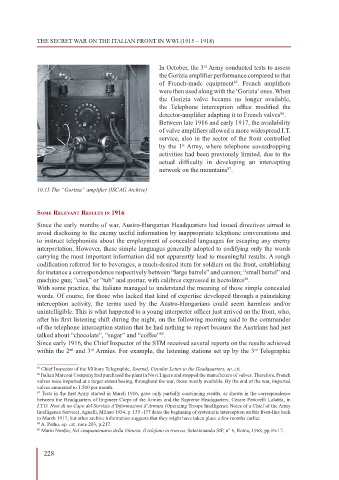
                                                         In October, the 3  Army conducted tests to assess
                                                                         rd
                                                         the Gorizia amplifier performance compared to that
                                                         of French-made  equipment .  French  amplifiers
                                                                                   85
                                                         were then used along with the ‘Gorizia’ ones. When
                                                         the Gorizia valve became  no longer available,
                                                         the  Telephone  interception  office  modified  the
                                                         detector-amplifier adapting it to French valves .
                                                                                                   86
                                                         Between late 1916 and early 1917, the availability
                                                         of valve amplifiers allowed a more widespread I.T.
                                                         service, also in the sector of the front controlled
                                                         by the 1  Army, where telephone eavesdropping
                                                                 st
                                                         activities had been previously limited, due to the
                                                         actual  difficulty  in  developing  an  intercepting
                                                         network on the mountains .
                                                                                 87


              10.15 The “Gorizia” amplifier (ISCAG Archive)


              soMe relevanT resulTs In 1916
              Since the early months of war, Austro-Hungarian Headquarters had issued directives aimed to
              avoid disclosing to the enemy useful information by inappropriate telephone conversations and
              to instruct telephonists about the employment of concealed languages for escaping any enemy
              interpretation. However, these simple languages generally adopted to codifying only the words
              carrying the most important information did not apparently lead to meaningful results. A rough
              codification referred for to beverages, a much-desired item for soldiers on the front, establishing
              for instance a correspondence respectively between “large barrels” and cannon; “small barrel” and
              machine gun; “cask” or “tub” and mortar, with calibres expressed in hectolitres .
                                                                                       88
              With some practice, the Italians managed to understand the meaning of those simple concealed
              words. Of course, for those who lacked that kind of expertise developed through a painstaking
              interception  activity, the  terms  used by the  Austro-Hungarians  could  seem harmless  and/or
              unintelligible. This is what happened to a young interpreter officer just arrived on the front, who,
              after his first listening shift during the night, on the following morning said to the commander
              of the telephone interception station that he had nothing to report because the Austrians had just
              talked about “chocolate”, “sugar” and “coffee” .
                                                         89
              Since early 1916, the Chief Inspector of the STM received several reports on the results achieved
              within the 2  and 3  Armies. For example, the listening stations set up by the 3  Telegraphic
                                                                                          rd
                         nd
                                 rd
              85  Chief Inspector of the Military Telegraphic, Journal, Circular Letter to the Headquarters, op. cit.
              86  Italian Marconi Company had purchased the plant in Novi Ligure and stopped the manufacture of valves. Therefore, French
              valves were imported at a larger extent beeing, throughout the war, those mostly available. By the end of the war, imported
              valves amounted to 1.500 per month.
              87  Tests in the first Army started in March 1916, gave only partially convincing results, as shown in the correspondence
              between the Headquarters of Engineer Corps of the Armies and the Supreme Headquarters. Cesare Pettorelli Lalattta, in
              I.T.O. Note di un Capo del Servizio d’Informazioni d’Armata (Operating Troops Intelligence Notes of a Chief of the Army
              Intelligence Service), Agnelli, Milano 1934, p. 135 -137 dates the beginning of systematic interception on this front-line back
              to March 1917, but other archive information suggests that they might have taken place a few months earlier.
              88  A. Petho, op. cit., note 203, p.217.
              89  Mario Nordio, Nel cinquantenario della Vittoria. Il telefono in trincea, Selezionando SIP, n° 6, Roma, 1968, pp.16-17.


                228

