


Page 226 - The Secret War in the Italian front in WWI (1915-1918)
P. 226
THE SECRET WAR ON THE ITALIAN FRONT IN WWI (1915 – 1918)


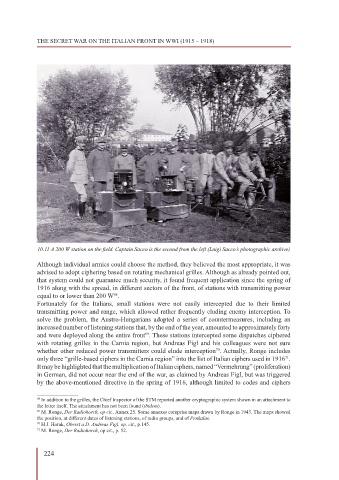
              10.11 A 200 W station on the field. Captain Sacco is the second from the left (Luigi Sacco’s photographic archive)

              Although individual armies could choose the method, they believed the most appropriate, it was
              advised to adopt ciphering based on rotating mechanical grilles. Although as already pointed out,
              that system could not guarantee much security, it found frequent application since the spring of
              1916 along with the spread, in different sectors of the front, of stations with transmitting power
              equal to or lower than 200 W .
                                         68
              Fortunately  for the  Italians,  small  stations  were  not  easily  intercepted  due  to  their  limited
              transmitting power and range, which allowed rather frequently eluding enemy interception. To
              solve the problem,  the Austro-Hungarians adopted  a series of countermeasures,  including  an
              increased number of listening stations that, by the end of the year, amounted to approximately forty
              and were deployed along the entire front . These stations intercepted some dispatches ciphered
                                                    69
              with rotating grilles in the Carnia region, but Andreas Figl and his colleagues were not sure
              whether other reduced power transmitters could elude interception . Actually, Ronge includes
                                                                             70
              only three “grille-based ciphers in the Carnia region” into the list of Italian ciphers used in 1916 .
                                                                                                     71
              It may be highlighted that the multiplication of Italian ciphers, named “Vermehrung” (proliferation)
              in German, did not occur near the end of the war, as claimed by Andreas Figl, but was triggered
              by the above-mentioned directive in the spring of 1916, although limited to codes and ciphers


              68  In addition to the grilles, the Chief Inspector of the STM reported another cryptographic system shown in an attachment to
              the letter itself. The attachment has not been found (ibidem).
              69  M. Ronge, Der Radiohorch, op cit., Annex 25. Some annexes comprise maps drawn by Ronge in 1943. The maps showed
              the position, at different dates of listening stations, of radio groups, and of Penkalas.
              70  H.J. Horak, Oberst a.D. Andreas Figl, op. cit., p.145.
              71  M. Ronge, Der Radiohorch, op cit., p. 52.


                224

