


Page 224 - The Secret War in the Italian front in WWI (1915-1918)
P. 224
THE SECRET WAR ON THE ITALIAN FRONT IN WWI (1915 – 1918)


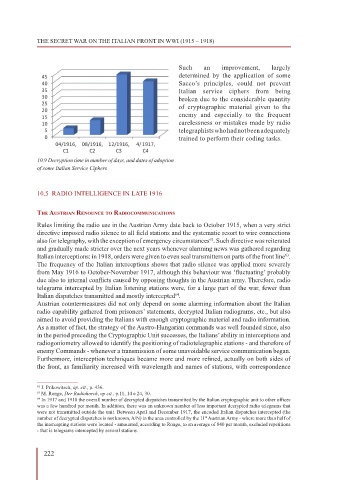
                                                                Such     an    improvement,     largely
                                                                determined by the application of some
                                                                Sacco’s principles, could not prevent
                                                                Italian service ciphers from being
                                                                broken due to the considerable quantity
                                                                of cryptographic material given to the
                                                                enemy and especially to the frequent
                                                                carelessness or mistakes made by radio
                                                                telegraphists who had not been adequately
                                                                trained to perform their coding tasks.


              10.9 Decryption time in number of days, and dates of adoption
              of some Italian Service Ciphers


              10.5  RADIO INTELLIGENCE IN LATE 1916


              The ausTrIan renounce To radIocoMMunIcaTIons
              Rules limiting the radio use in the Austrian Army date back to October 1915, when a very strict
              directive imposed radio silence to all field stations and the systematic resort to wire connections
              also for telegraphy, with the exception of emergency circumstances . Such directive was reiterated
                                                                           62
              and gradually made stricter over the next years whenever alarming news was gathered regarding
              Italian interceptions: in 1918, orders were given to even seal transmitters on parts of the front line .
                                                                                                     63
              The frequency of the Italian interceptions shows that radio silence was applied more severely
              from May 1916 to October-November 1917, although this behaviour was ‘fluctuating’ probably
              due also to internal conflicts caused by opposing thoughts in the Austrian army. Therefore, radio
              telegrams intercepted by Italian listening stations were, for a large part of the war, fewer than
              Italian dispatches transmitted and mostly intercepted .
                                                               64
              Austrian countermeasures did not only depend on some alarming information about the Italian
              radio capability gathered from prisoners’ statements, decrypted Italian radiograms, etc., but also
              aimed to avoid providing the Italians with enough cryptographic material and radio information.
              As a matter of fact, the strategy of the Austro-Hungarian commands was well founded since, also
              in the period preceding the Cryptographic Unit successes, the Italians’ ability in interceptions and
              radiogoniometry allowed to identify the positioning of radiotelegraphic stations - and therefore of
              enemy Commands - whenever a transmission of some unavoidable service communication began.
              Furthermore, interception techniques became more and more refined, actually on both sides of
              the front, as familiarity increased with wavelength and names of stations, with correspondence


              62  J. Prikowitsch, op. cit., p. 436.
              63  M. Ronge, Der Radiohorch, op cit., p.11, 14 e 24, 30.
              64  In 1917 and 1918 the overall number of decrypted dispatches transmitted by the Italian cryptographic unit to other offices
              was a few hundred per month. In addition, there was an unknown number of less important decrypted radio telegrams that
              were not transmitted outside the unit. Between April and December 1917, the encoded Italian dispatches intercepted (the
              number of decrypted dispatches is not known, A/N) in the area controlled by the 11 Austrian Army - where more than half of
                                                                         th
              the intercepting stations were located - amounted, according to Ronge, to an average of 840 per month, excluded repetitions
              - that is telegrams intercepted by several stations.


                222

