


Page 216 - The Secret War in the Italian front in WWI (1915-1918)
P. 216
THE SECRET WAR ON THE ITALIAN FRONT IN WWI (1915 – 1918)


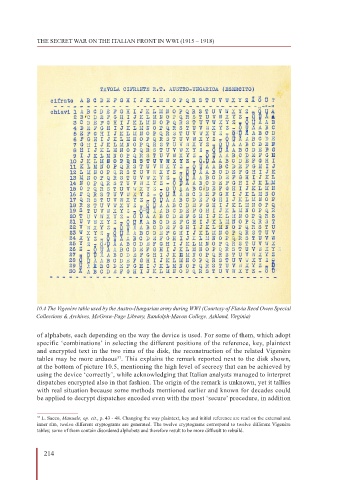
              10.4 The Vigenère table used by the Austro-Hungarian army during WWI (Courtesy of Flavia Reed Owen Special
              Collections & Archives, McGraw-Page Library, Randolph-Macon College, Ashland, Virginia)


              of alphabets, each depending on the way the device is used. For some of them, which adopt
              specific ‘combinations’ in selecting the different positions of the reference, key, plaintext
              and encrypted text in the two rims of the disk, the reconstruction of the related Vigenère
              tables may be more arduous . This explains the remark reported next to the disk shown,
                                          37
              at the bottom of picture 10.5, mentioning the high level of secrecy that can be achieved by
              using the device ‘correctly’, while acknowledging that Italian analysts managed to interpret
              dispatches encrypted also in that fashion. The origin of the remark is unknown, yet it tallies
              with real situation because some methods mentioned earlier and known for decades could
              be applied to decrypt dispatches encoded even with the most ‘secure’ procedure, in addition


              37  L. Sacco, Manuale, op. cit., p. 43 - 48. Changing the way plaintext, key and initial reference are read on the external and
              inner rim, twelve different cryptograms are generated. The twelve cryptograms correspond to twelve different Vigenère
              tables; some of them contain disordered alphabets and therefore result to be more difficult to rebuild.


                214

