


Page 217 - The Secret War in the Italian front in WWI (1915-1918)
P. 217
CHAPTER TEN


                  to other more sophisticated
                  procedures .
                             38
                  In his book,  Andreas Figl
                  does not  explicitly  say that
                  the Austro-Hungarian  army
                  used ciphers derived from the
                  Vigenère table during  WWI:
                  yet he affirms that in that period
                  those systems were considered
                  reliable by the armed forces of
                  several countries because “they
                  guaranteed sufficient security
                  although    under     specific
                  circumstances”,      therefore
                  “their application can seem
                  admissible still today” .
                                        39
                  It should be noted that
                  in    operational   situations
                  occurring   on    the   front-
                  line during combat, the
                  conditions Figl alludes to,
                  such as the application of
                  above-mentioned      methods
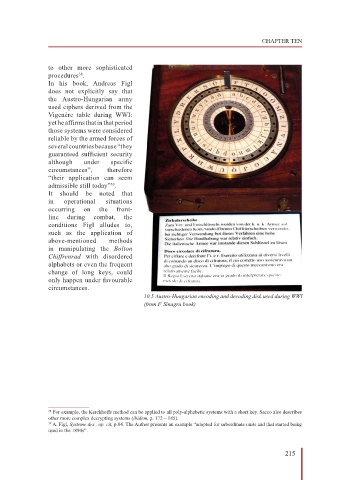
                  in manipulating the  Bolton
                  Chiffrenrad  with disordered
                  alphabets or even the frequent
                  change of long keys, could
                  only happen under favourable
                  circumstances.
                                                    10.5 Austro-Hungarian encoding and decoding disk used during WWI
                                                    (from F. Sinagra book)


                  38  For example, the Kerckhoffs method can be applied to all poly-alphabetic systems with a short key. Sacco also describes
                  other more complex decrypting systems (ibidem, p. 172 – 185).
                  39  A. Figl, Systeme des., op. cit, p.84. The Author presents an example “adopted for subordinate units and that started being
                  used in the 1890s”.


                                                                                                     215

