


Page 255 - The Secret War in the Italian front in WWI (1915-1918)
P. 255
CHAPTER ELEVEN


                  After a series of bureaucratic  postponements, the
                  distribution of the final edition of the Code D also called
                  Dizionario di sillabe e parole (Dictionary of syllables and
                  words), occurred on 10 December and deferred, for some
                  units, until 24 January 1918 .
                                            74
                  O. Marchetti recalled that “a coding and decoding dictionary
                  for lower units” was adopted in June 1917 instead of the
                  Pocket Military Cipher. The difference between the two
                  dates - June and December 1917 - could be the result of
                  either an error by Marchetti or the adoption, in June 1917,
                  of a dictionary equal or analogous to the already mentioned
                  Small Telephone Code compiled by Luigi Sacco in 1916.
                  No evidence supports this assumption to date, though it
                  is worth to mention that Ronge assumed in his memoirs
                  of 1943 that Marchetti’s pieces of information and date .
                                                                     75
                  Summarised below are the fundamental characteristics of
                  the D code taken from a ‘blank form’ with pencil notes
                  corrections  and  comments,  probably  by  Sacco  himself,
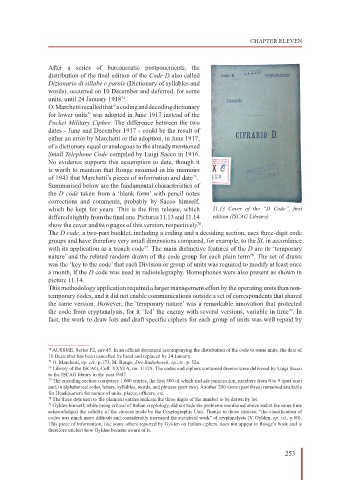
                  which he kept for years. This is the first release, which   11.13  Cover  of  the  “D  Code”,  first
                  differed slightly from the final one. Pictures 11.13 and 11.14   edition (ISCAG Library)
                  show the cover and two pages of this version, respectively .
                                                                      76
                  The D code, a two-part booklet, including a coding and a decoding section, uses three-digit code
                  groups and have therefore very small dimensions compared, for example, to the SI, in accordance
                  with its application as a trench code . The main distinctive features of the D are its ‘temporary
                                                    77
                  nature’ and the related random drawn of the code group for each plain term . The set of draws
                                                                                         78
                  was the ‘key to the code’ that each Division or group of units was required to modify at least once
                  a month, if the D code was used in radiotelegraphy. Homophones were also present as shown in
                  picture 11.14.
                  This methodology application required a larger management effort by the operating units than non-
                  temporary codes, and it did not enable communications outside a set of correspondents that shared
                  the same version. However, the ’temporary nature’ was a remarkable innovation that protected
                  the code from cryptanalysis, for it ‘fed’ the enemy with several versions, variable in time . In
                                                                                                      79
                  fact, the work to draw lots and draft specific ciphers for each group of units was well repaid by


                  74  AUSSME, Series F2, env.45. In an official document accompanying the distribution of the code to some units, the date of
                  10 December has been cancelled by hand and replaced by 24 January.
                  75  O. Marchetti, op. cit., p.173, M. Ronge, Der Radiohorch, op cit., p. 52a.
                  76  Library of the ISCAG, Coll. XXXI A, no. 11129. The codes and ciphers contained therein were delivered by Luigi Sacco
                  to the ISCAG library in the year 1947.
                  77  The encoding section comprises 1.000 entries, the first 800 of which include punctuation, numbers from 0 to 9 (part one)
                  and, in alphabetical order, letters, syllables, words, and phrases (part two). Another 200 items (part three) remained available
                  for Headquarters for names of units, places, officers, etc.
                  78  The three dots next to the plaintext entries indicate the three digits of the number to be drawn by lot.
                  79  Gylden himself, while being critical of Italian cryptology, did not hide the problems mentioned above and at the same time
                  acknowledged the validity of the choices made by the Cryptographic Unit. Thanks to those choices, “the classification of
                  codes was much more difficult and considerably increased the statistical work” of cryptanalysts (Y. Gylden, op. cit., p.80).
                  This piece of information, like some others reported by Gylden on Italian ciphers, does not appear in Ronge’s book and is
                  therefore unclear how Gylden became aware of it.


                                                                                                     253

