


Page 258 - The Secret War in the Italian front in WWI (1915-1918)
P. 258
THE SECRET WAR ON THE ITALIAN FRONT IN WWI (1915 – 1918)


              enemy lines, at the beginning of 1917 the Italian Air Force technicians designed a 180 W station
              called T.Av. with a range of up to 60 kilometres. Three Italian companies were entrusted with its
              industrial production (picture 11.15) .
                                               81
              Thanks to the space and energy available
              on board, airships could carry transmitters
              of  higher  power  than  planes;  moreover,
              reception of ground stations transmission
              and some kinds of radio navigation aids
              were also possible thanks to silence in flight.
              The risks of sparking fires originated from
              the contemporary presence in the nacelle of
              spark devices and hydrogen, was avoided
              by adopting the valve transmitters tested
              in 1917 by Guglielmo Marconi on Italian
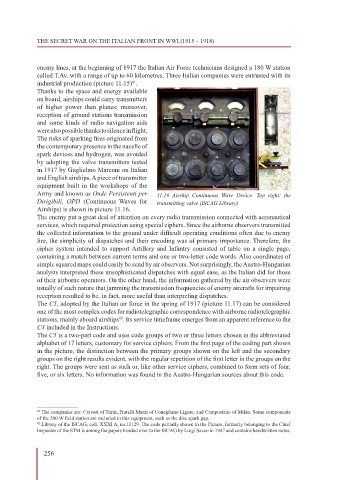
              and English airships. A piece of transmitter
              equipment built in the workshops of the
              Army and known as Onde Persistenti per    11.16  Airship  Continuous  Wave  Device.  Top  right:  the
              Dirigibili,  OPD  (Continuous Waves  for   transmitting valve (ISCAG Library)
              Airships) is shown in picture 11.16.
              The enemy put a great deal of attention on every radio transmission connected with aeronautical
              services, which required protection using special ciphers. Since the airborne observers transmitted
              the collected information to the ground under difficult operating conditions often due to enemy
              fire, the simplicity of dispatches and their encoding was of primary importance. Therefore, the
              cipher  system intended  to  support Artillery  and Infantry  consisted  of table  on a single  page,
              containing a match between current terms and one or two-letter code words. Also coordinates of
              simple squared maps could easily be send by air observers. Not surprisingly, the Austro-Hungarian
              analysts interpreted these unsophisticated dispatches with equal ease, as the Italian did for those
              of their airborne operators. On the other hand, the information gathered by the air observers were
              usually of such nature that jamming the transmission frequencies of enemy aircrafts for impairing
              reception resulted to be, in fact, more useful than interpreting dispatches.
              The C5, adopted by the Italian air force in the spring of 1917 (picture 11.17) can be considered
              one of the most complex codes for radiotelegraphic correspondence with airborne radiotelegraphic
              stations, mainly aboard airships . Its service timeframe emerges from an apparent reference to the
                                           82
              C4 included in the Instructions.
              The C5 is a two-part code and uses code groups of two or three letters chosen in the abbreviated
              alphabet of 17 letters, customary for service ciphers. From the first page of the coding part shown
              in the picture, the distinction between the primary groups shown on the left and the secondary
              groups on the right results evident, with the regular repetition of the first letter in the groups on the
              right. The groups were sent as such or, like other service ciphers, combined to form sets of four,
              five, or six letters. No information was found in the Austro-Hungarian sources about this code.


              81  The companies are: Craveri of Turin, Fratelli Marzi of Conegliano Ligure, and Campostano of Milan. Some components
              of the 200 W field station are included in this equipment, such as the disc spark gap.
              82  Library of the ISCAG, coll. XXXI A, no.11129. The code partially shown in the Picture, formerly belonging to the Chief
              Inspector of the STM is among the papers handed over to the ISCAG by Luigi Sacco in 1947 and contains handwritten notes.


                256

