


Page 263 - The Secret War in the Italian front in WWI (1915-1918)
P. 263
CHAPTER ELEVEN


                                                                 generators producing currents of much higher
                                                                 intensity, causing loud and annoying noise for
                                                                 the interceptors .
                                                                               90
                                                                 The I.T. Service was also responsible for
                                                                 monitoring  communications  between  the
                                                                 Italian units to verify the possibility they could
                                                                 be intercepted. In time, this activity took on
                                                                 the shape of actual censorship to ascertain, for
                                                                 example, the infringement of rules relating to
                                                                 personal or unauthorized telephone calls or to
                                                                 the lack of concealed  languages/ciphers  for
                                                                 relevant communications .
                                                                                        91

                                                                 a serIous danger for general boroevIc

                                                                 Several  excerpts of enemy telephone
                                                                 communications  intercepted  by the  stations
                                                                 of  Tivoli  (Gorizia), Sleme  and many others
                                                                 came from the Isonzo front concerning enemy
                                                                 critical operational situations.
                                                                 Particularly  noteworthy  was the  information
                                                                 achieved  in early May about a train  loaded
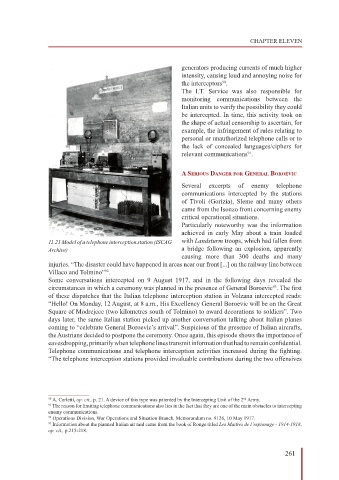
                  11.21 Model of a telephone interception station (ISCAG   with Landsturm troops, which had fallen from
                  Archive)                                       a bridge  following  an explosion,  apparently
                                                                 causing more than 300 deaths and many
                  injuries. “The disaster could have happened in areas near our front [...] on the railway line between
                  Villaco and Tolmino” .
                                      92
                  Some conversations intercepted on 9  August 1917, and in the following days revealed  the
                  circumstances in which a ceremony was planned in the presence of General Boroevic . The first
                                                                                                 93
                  of these dispatches that the Italian telephone interception station in Volzana intercepted reads:
                  “Hello! On Monday, 12 August, at 8 a.m., His Excellency General Boroevic will be on the Great
                  Square of Modrejece (two kilometres south of Tolmino) to award decorations to soldiers”. Two
                  days later, the same Italian station picked up another conversation talking about Italian planes
                  coming to “celebrate General Boroevic’s arrival”. Suspicious of the presence of Italian aircrafts,
                  the Austrians decided to postpone the ceremony. Once again, this episode shows the importance of
                  eavesdropping, primarily when telephone lines transmit information that had to remain confidential.
                  Telephone communications and telephone interception activities increased during the fighting.
                  “The telephone interception stations provided invaluable contributions during the two offensives


                                                                                      nd
                  90  A. Carletti, op. cit., p. 21. A device of this type was patented by the Intercepting Unit of the 2  Army.
                  91  The reason for limiting telephone communications also lies in the fact that they are one of the main obstacles to intercepting
                  enemy communications.
                  92  Operations Division, War Operations and Situation Branch, Memorandum no. 9126, 10 May 1917.
                  93  Information about the planned Italian air raid came from the book of Ronge titled Les Maitres de l’espionage - 1914-1918,
                  op. cit., p.215-218.


                                                                                                     261

