


Page 301 - The Secret War in the Italian front in WWI (1915-1918)
P. 301
CHAPTER THIRTEEN


                  Unit became aware of this evolution, and in the last months of the conflict included this code
                  among those in service inside units above the Division .
                                                                    18
                  In his memoirs, Ronge mentioned the D code only once, that is, when it was found on an Italian
                  Cavalry Officer captured on 9 July 1918, also mentioning in a note that the code had been adopted
                  shortly before, showing little knowledge not only about the time of code introduction, but also of
                  the possible similarity with the ‘syllables and words cipher’ that Ronge believed had been adopted
                  in June of the previous year .
                                           19
                  However, besides acquiring the code booklet on that occasion, any Austrian attempt for decrypting
                  dispatches encoded with the D was unsuccessful, apart from eventual messages coded with the
                  edition found on the captured Italian Officer and only before it was radically modified under its
                  instructions for use.


                  The r code
                  In April 1918, the R (Regimental) code was distributed to the Headquarters of the Infantry Regiments
                  and equivalent units of other combat Arms. It was meant to provide a handy cipher protecting the
                  secrecy of phonograms, but also of radiograms exchanged between smaller combat units.
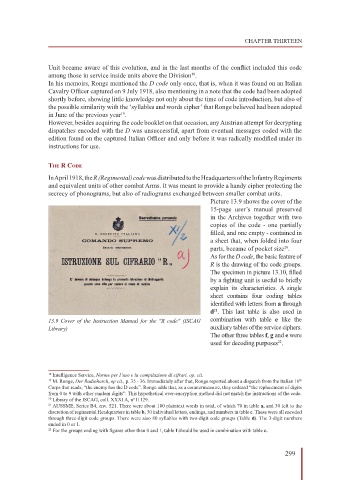
                                                                           Picture 13.9 shows the cover of the
                                                                           15-page  user’s manual  preserved
                                                                           in the Archives together with two
                                                                           copies of the code - one partially
                                                                           filled, and one empty - contained in
                                                                           a sheet that, when folded into four
                                                                           parts, became of pocket size .
                                                                                                     20
                                                                           As for the D code, the basic feature of
                                                                           R is the drawing of the code groups.
                                                                           The specimen in picture 13.10, filled
                                                                           by a fighting unit is useful to briefly
                                                                           explain its characteristics.  A single
                                                                           sheet contains four coding tables
                                                                           identified with letters from a through
                                                                           d .  This last table is also used in
                                                                            21
                  13.9  Cover  of  the  Instruction  Manual  for  the  "R  code"  (ISCAG   combination with table  e like the
                  Library)                                                 auxiliary tables of the service ciphers.
                                                                           The other three tables f, g and e were
                                                                           used for decoding purposes .
                                                                                                   22


                  18  Intelligence Service, Norme per l’uso e la compilazione di cifrari, op. cit.
                  19  M. Ronge, Der Radiohorch, op cit., p. 35 - 36. Immediately after that, Ronge reported about a dispatch from the Italian 16
                                                                                                          th
                  Corps that reads, “the enemy has the D code”. Ronge adds that, as a countermeasure, they ordered “the replacement of digits
                  from 0 to 9 with other random digits”. This hypothetical over-encryption method did not match the instructions of the code.
                  20  Library of the ISCAG, coll. XXXI A, n°11129.
                  21  AUSSME, Series B4, env. 521. There were about 100 plaintext words in total, of which 70 in table a, and 30 left to the
                  discretion of regimental Headquarters in table b; 30 individual letters, endings, and numbers in table c. These were all encoded
                  through three-digit code groups. There were also 80 syllables with two-digit code groups (Table d). The 3-digit numbers
                  ended in 0 or 1.
                  22  For the groups ending with figures other than 0 and 1, table f should be used in combination with table e.


                                                                                                     299

