


Page 304 - The Secret War in the Italian front in WWI (1915-1918)
P. 304
THE SECRET WAR ON THE ITALIAN FRONT IN WWI (1915 – 1918)


              a ‘strategy’ peculiar to the Austrian army compared to that adopted by the other belligerent Armies.
              However, in the following months, the intensity of radio usage fluctuated, following the events
              occurring on the front, but probably also for divergence of views among the higher Headquarters.
              The new encoding system for radio stations came into force on 20 March 1918 and was based
              on the Ignaz Technical Code - which the Italians already knew - and a new two-part, three-digit
              code known as the 3stelliger Radiocodex. An overencoding table could also be associated which
              consisted of a disordered series of three-digit numbers to be added to the code groups, by indicating
              at the beginning of each telegram the number chosen as the first adopted in the over coding list .
                                                                                                     28
              Whether and to what extent the table was used in practice is not known.
              On the 20  of April, however, an unexpected event occurred: the Austrians intercepted an Italian
                       th
              radio dispatch containing some information obtained from the interception and decrypting of an
              enemy (Austrian) telegram. Therefore, the Austro-Hungarian Headquarters ordered their Isonzo
              Armies to “put a lead seal” onto their transmitters, thus preventing any radio transmission, and
              extended the same ban to the Navy stations .
                                                      29
              Therefore, the 3stelliger Radiocodex, probably used without over-encoding tables possibly giving rise to
              the decrypting mentioned by the Italian intercepted dispatch, remained in service not for long, at least in
              most of the front. Lead seals did not last long either, since in fact before the Second Battle of the Piave
              river, that is, at the end of May1918, Austro-Hungarian radio traffic became strong again.
              On that occasion, new two - books divisional codes of limited size without over encoding were
              introduced, for the entire front or for single armies which, as shown in the next paragraphs, the
              Italians broke with some effort and much insight, during the Battle.


              The PreParaTIon of The second PIave baTTle
              The brilliant results obtained by the 1
                                                st
              Radio goniometric Section in November
              and December of 1917 continued in
              the following year when its network
              included some direction-finding mobile
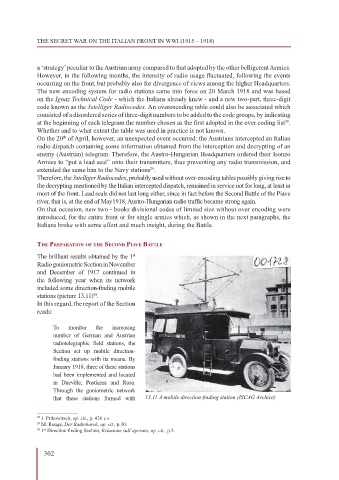
              stations (picture 13.11) .
                                  30
              In this regard, the report of the Section
              reads:


                    To   monitor   the  increasing
                    number of German and  Austrian
                    radiotelegraphic  field  stations,  the
                    Section  set  up  mobile  direction-
                    finding stations with its means. By
                    January 1918, three of these stations
                    had been implemented and located
                    in Dueville, Postiama and Rosa.
                    Through the goniometric network
                    that these stations formed with   13.11 A mobile direction-finding station (ISCAG Archive)


              28  J. Prikowitsch, op. cit., p. 426 e s.
              29  M. Ronge, Der Radiohorch, op. cit., p.30.
              30  1  Direction finding Section, Relazione sull’operato, op. cit., p.3.
                st

                302

