


Page 308 - The Secret War in the Italian front in WWI (1915-1918)
P. 308
THE SECRET WAR ON THE ITALIAN FRONT IN WWI (1915 – 1918)


                    after the first days of somewhat rational use of the code, we were lucky to intercept radio
                    dispatches in which the abundance of repetitions indicated letter-by-letter encoding had been
                    frequently used [...] On 20 June, two radio dispatches (of this type, A/N) were intercepted
                    from an Austrian station that radiogoniometry pinpointed on the Colle della Guardia, near
                    Conegliano .
                             35
              Letter-by-letter encoding greatly facilitates cryptanalysis because operators could apply frequency
              analysis which usually requires having many cryptograms available. In this case, however, Luigi
              Sacco just needed two radio telegrams to start breaking the code, thanks to his intuition, which
              Bauer did not hesitate to define as “splendid” .
                                                        36
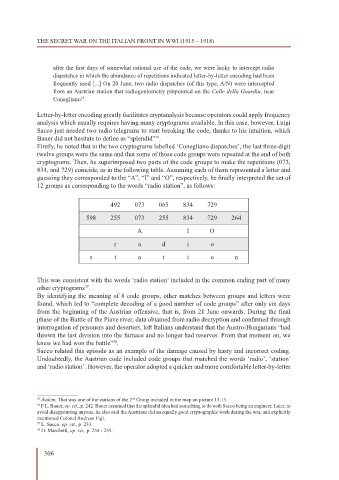
              Firstly, he noted that in the two cryptograms labelled ‘Conegliano dispatches’, the last three-digit
              twelve groups were the same and that some of those code groups were repeated at the end of both
              cryptograms. Then, he superimposed two parts of the code groups to make the repetitions (073,
              834, and 729) coincide, as in the following table. Assuming each of them represented a letter and
              guessing they corresponded to the “A”, “I” and “O”, respectively, he finally interpreted the set of
              12 groups as corresponding to the words “radio station”, as follows:


                                        492     073      065     834      729

                               598      255     073      255     834      729     264

                                                 A                 I       O
                                         r        a       d        i       o

                                 s       t        a       t        i       o       n


              This was consistent with the words ‘radio station’ included in the common ending part of many
              other cryptograms .
                               37
              By identifying the meaning of 8 code groups, other matches between groups and letters were
              found, which led to “complete decoding of a good number of code groups” after only six days
              from the beginning of the Austrian offensive, that is, from 21 June onwards. During the final
              phase of the Battle of the Piave river, data obtained from radio decryption and confirmed through
              interrogation of prisoners and deserters, left Italians understand that the Austro-Hungarians “had
              thrown the last division into the furnace and no longer had reserves. From that moment on, we
              knew we had won the battle” .
                                         38
              Sacco related this episode as an example of the damage caused by hasty and incorrect coding.
              Undoubtedly, the Austrian code included code groups that matched the words ‘radio’, ‘station’
              and ‘radio station’. However, the operator adopted a quicker and more comfortable letter-by-letter


                                               nd
              35  ibidem. That was one of the stations of the 2  Group included in the map on picture 13.13.
              36  F L. Bauer, op. cit., p. 242. Bauer assumed that the splendid idea had something to do with Sacco being an engineer. Later, to
              avoid disappointing anyone, he also said the Austrians did an equally good cryptographic work during the war, and explicitly
              mentioned Colonel Andreas Figl.
              37  L. Sacco, op. cit., p. 233.
              38  O. Marchetti, op. cit., p. 234 - 235.


                306

