


Page 310 - The Secret War in the Italian front in WWI (1915-1918)
P. 310
THE SECRET WAR ON THE ITALIAN FRONT IN WWI (1915 – 1918)


              13.4  THE SWITCHING TO NEW CODES IN THE AUSTRIAN ARMY


              sIgnalordung and schlüsselhefT

              The replacement of the Austrian two-parts codes take place in July 1918, with a new method
              reproducing a divisional system applied by the German army since January of the same year: the
              so called Schlüsselheft .
                                   44
              The new system consisted of two parts: the first called Signalordung (Signalling Regulations), was
              a booklet that set out the communication rules at divisional level, while the second was a one-part
              code called Schlüsselheft (Encoding Booklet) with two tables for encoding and decoding, named
              Geheimklappe (Secret Handkerchief).
              The Schlüsselheft could be applied to radiotelegraphy as well as to telephone communications,
              light signals, and geo-telegraphy . This code consisted of 38 pages including an alphabetical
                                             45
              dictionary; a list of letters, syllables, and numbers; some short standard messages to be used
              in combat; a series of abbreviations and a blank list, to be drawn up by each command. There
              were  no traces  of homophones
              in any list. Such a code ensured
              no secrecy and could only be
              used as such only in particular
              circumstances,  for example for
              short communications by aircraft
              in flight.
              Over-encoding  was therefore
              needed  through encoding and
              decoding tables (Geheimklappe).
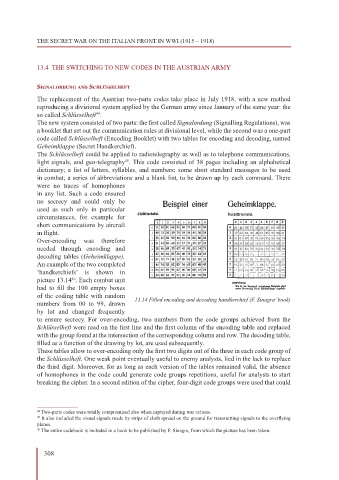
              An example of the two completed
              ‘handkerchiefs’ is shown in
              picture 13.14 . Each combat unit
                          46
              had  to  fill  the  100  empty  boxes
              of the coding table with random   13.14 Filled encoding and decoding handkerchief (F. Sinagra' book)
              numbers from 00 to 99, drawn
              by lot and changed frequently
              to ensure secrecy. For  over-encoding, two numbers from the code groups  achieved from the
              Schlüsselheft were read on the first line and the first column of the encoding table and replaced
              with the group found at the intersection of the corresponding column and row. The decoding table,
              filled as a function of the drawing by lot, are used subsequently.
              These tables allow to over-encoding only the first two digits out of the three in each code group of
              the Schlüsselheft. One weak point eventually useful to enemy analysts, lied in the lack to replace
              the third digit. Moreover, for as long as each version of the tables remained valid, the absence
              of homophones in the code could generate code groups repetitions, useful for analysts to start
              breaking the cipher. In a second edition of the cipher, four-digit code groups were used that could


              44  Two-parts codes were totally compromised also when captured during war actions.
              45  It also included the visual signals made by strips of cloth spread on the ground for transmitting signals to the overflying
              planes.
              46  The entire codebook is included in a book to be published by F. Sinagra, from which the picture has been taken.


                308

