


Page 315 - The Secret War in the Italian front in WWI (1915-1918)
P. 315
CHAPTER THIRTEEN


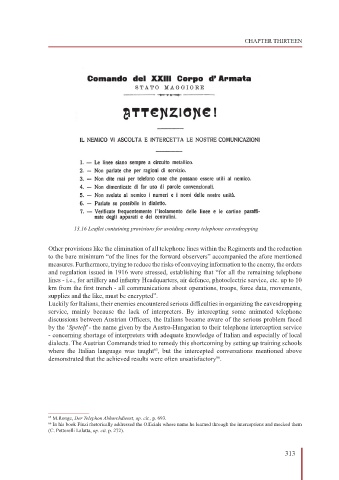
                           13.16 Leaflet containing provisions for avoiding enemy telephone eavesdropping


                  Other provisions like the elimination of all telephone lines within the Regiments and the reduction
                  to the bare minimum “of the lines for the forward observers” accompanied the afore mentioned
                  measures. Furthermore, trying to reduce the risks of conveying information to the enemy, the orders
                  and regulation issued in 1916 were stressed, establishing that “for all the remaining telephone
                  lines - i.e., for artillery and infantry Headquarters, air defence, photoelectric service, etc. up to 10
                  km from the first trench - all communications about operations, troops, force data, movements,
                  supplies and the like, must be encrypted”.
                  Luckily for Italians, their enemies encountered serious difficulties in organizing the eavesdropping
                  service, mainly  because the lack of interpreters.  By intercepting  some animated  telephone
                  discussions between Austrian Officers, the Italians became aware of the serious problem faced
                  by the ‘Spetelf’- the name given by the Austro-Hungarian to their telephone interception service
                  - concerning shortage of interpreters with adequate knowledge of Italian and especially of local
                  dialects. The Austrian Commands tried to remedy this shortcoming by setting up training schools
                  where  the  Italian  language  was taught , but  the  intercepted  conversations  mentioned  above
                                                       65
                  demonstrated that the achieved results were often unsatisfactory .
                                                                             66


                  65  M.Ronge, Der Telephon Abhorchdienst, op. cit., p. 693.
                  66  In his book Finzi rhetorically addressed the Officials whose name he learned through the interceptions and mocked them
                  (C. Pettorelli Lalatta, op. cit. p. 272).


                                                                                                     313

