


Page 351 - The Secret War in the Italian front in WWI (1915-1918)
P. 351
ANNEX A


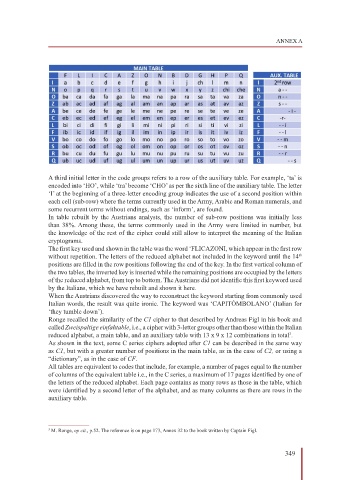
                  A third initial letter in the code groups refers to a row of the auxiliary table. For example, ‘ta’ is
                  encoded into ‘HO’, while ‘tra’ become ‘CHO’ as per the sixth line of the auxiliary table. The letter
                  ‘I’ at the beginning of a three-letter encoding group indicates the use of a second position within
                  each cell (sub-row) where the terms currently used in the Army, Arabic and Roman numerals, and
                  some recurrent terms without endings, such as ‘inform’, are found.
                  In  table  rebuilt  by  the Austrians  analysts,  the  number  of  sub-row positions  was initially  less
                  than 38%. Among these, the terms commonly used in the Army were limited in number, but
                  the knowledge of the rest of the cipher could still allow to interpret the meaning of the Italian
                  cryptograms.
                  The first key used and shown in the table was the word ‘FLICAZONI, which appear in the first row
                  without repetition. The letters of the reduced alphabet not included in the keyword until the 14
                                                                                                          th
                  positions are filled in the row positions following the end of the key. In the first vertical column of
                  the two tables, the inverted key is inserted while the remaining positions are occupied by the letters
                  of the reduced alphabet, from top to bottom. The Austrians did not identifie this first keyword used
                  by the Italians, which we have rebuilt and shown it here.
                  When the Austrians discovered the way to reconstruct the keyword starting from commonly used
                  Italian words, the result was quite ironic. The keyword was ‘CAPITÓMBOLANO’ (Italian for
                  ‘they tumble down’).
                  Ronge recalled the similarity of the C1 cipher to that described by Andreas Figl in his book and
                  called Zweispaltige einfahtable, i.e., a cipher with 3-letter groups other than those within the Italian
                  reduced alphabet, a main table, and an auxiliary table with 13 x 9 x 12 combinations in total .
                                                                                                       3
                  As shown in the text, some C series ciphers adopted after C1 can be described in the same way
                  as C1, but with a greater number of positions in the main table, as in the case of C2, or using a
                  “dictionary”, as in the case of CF.
                  All tables are equivalent to codes that include, for example, a number of pages equal to the number
                  of columns of the equivalent table i.e., in the C series, a maximum of 17 pages identified by one of
                  the letters of the reduced alphabet. Each page contains as many rows as those in the table, which
                  were identified by a second letter of the alphabet, and as many columns as there are rows in the
                  auxiliary table.


                  3  M. Ronge, op cit., p.52. The reference is on page 173, Annex 32 to the book written by Captain Figl.


                                                                                                     349

