


Page 37 - The Secret War in the Italian front in WWI (1915-1918)
P. 37
CHAPTER TWO


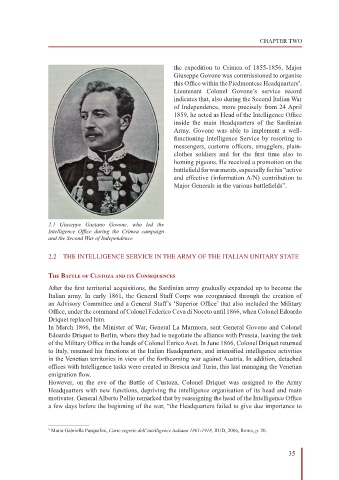
                                                              the expedition to Crimea  of 1855-1856, Major
                                                              Giuseppe Govone was commissioned to organise
                                                              this Office within the Piedmontese Headquarters .
                                                                                                          9
                                                              Lieutenant  Colonel  Govone’s service  record
                                                              indicates that, also during the Second Italian War
                                                              of Independence, more precisely from 24 April
                                                              1859, he acted as Head of the Intelligence Office
                                                              inside  the  main  Headquarters of the  Sardinian
                                                              Army. Govone was able  to implement  a well-
                                                              functioning Intelligence Service by resorting to
                                                              messengers, customs officers, smugglers, plain-
                                                              clothes  soldiers  and  for  the  first  time  also  to
                                                              homing pigeons. He received a promotion on the
                                                              battlefield for war merits, especially for his “active
                                                              and effective (information A/N) contribution to
                                                              Major Generals in the various battlefields”.


                  2.1  Giuseppe  Gaetano  Govone,  who  led  the
                  Intelligence  Office  during  the  Crimea  campaign
                  and the Second War of Independence


                  2.2  THE INTELLIGENCE SERVICE IN THE ARMY OF THE ITALIAN UNITARY STATE


                  The baTTle of cusToza and ITs consequences
                  After the first territorial acquisitions, the Sardinian army gradually expanded up to become the
                  Italian army. In early 1861, the General Staff Corps was reorganised through the creation of
                  an Advisory Committee and a General Staff’s ‘Superior Office’ that also included the Military
                  Office, under the command of Colonel Federico Ceva di Noceto until 1866, when Colonel Edoardo
                  Driquet replaced him.
                  In March 1866, the Minister of War, General La Marmora, sent General Govone and Colonel
                  Edoardo Driquet to Berlin, where they had to negotiate the alliance with Prussia, leaving the task
                  of the Military Office in the hands of Colonel Enrico Avet. In June 1866, Colonel Driquet returned
                  to Italy, resumed his functions at the Italian Headquarters, and intensified intelligence activities
                  in the Venetian territories in view of the forthcoming war against Austria. In addition, detached
                  offices with Intelligence tasks were created in Brescia and Turin, this last managing the Venetian
                  emigration flow.
                  However, on the  eve  of the  Battle  of Custoza,  Colonel  Driquet  was assigned  to  the  Army
                  Headquarters with new functions, depriving the intelligence organisation of its head and main
                  motivator. General Alberto Pollio remarked that by reassigning the head of the Intelligence Office
                  a few days before the beginning of the war, “the Headquarters failed to give due importance to


                  9  Maria Gabriella Pasqualini, Carte segrete dell’intelligence italiana 1861-1918, RUD, 2006, Roma, p. 20.


                                                                                                      35

