


Page 156 - Airpower in 20th Century - Doctrines and Employment
P. 156
156                            airpower in 20  Century doCtrines and employment - national experienCes
                                               tH


            Peace with Egypt and Jordan

               Within the framework of the agreement reached with the intervention of the US,
            the IDF withdrew from the west bank of the Suez Canal to new positions in Sinai,
            with UN forces forming a buffer between the Egyptian and Israeli forces on the
            ground. In the next couple of years the Egyptians, especially their president Anwar
            Saadat, finally realized that they could not regain the territory that had been lost
            in the Six Day War by force, and instead turned to a peaceful solution. After wide
            spread diplomatic activity, the Egyptian President came to Israel in November 1977
            and addressed the Israeli Parliament (The Knesset). The peace treaty between Israel
            and Egypt was signed in 1979 and in accordance with its terms, Israel withdrew from
            all of Sinai, the water way from the Red Sea to Eilat was opened, Sinai was demili-
            tarized, and ambassadors were exchanged between the two countries.
               Following this, a peace treaty was signed with Jordan in 1994, and Israel started to
            enjoy peace and co-operation along its two longest borders with Egypt and Jordan.


            The latest fighter aircrafts 1973-1982

               During this period the IAF received the very latest fighter aircrafts that were pro-
            duced in the United States – the F15’s and the F16’s, and also the newest helicopters
            both for attack and ground support purposes and for transport.
               Over the years, the IAF carried out many missions far from its borders which are
            still classified. However, two missions of this nature that have become known world
            wide are an indication of the IAF’s abilities and performance levels.


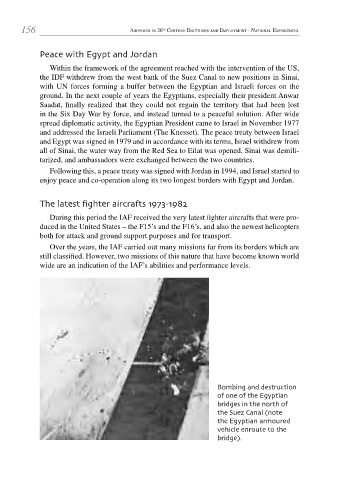
                                                               Bombing and destruction
                                                               of one of the Egyptian
                                                               bridges in the north of
                                                               the Suez Canal (note
                                                               the Egyptian armoured
                                                               vehicle enroute to the
                                                               bridge).

