


Page 319 - Airpower in 20th Century - Doctrines and Employment
P. 319
Turchia


            f. Rezzan Ünalp    *

            Turkish Air Campaigns during the

            Battles of çanakkale March 1915 - January 1916


            Introduction

                  hose, who wrote the history of the air power just before the World War I, have
                  attached little importance to the aerial aspects of the Ottoman-Italian war and
            TBalkan Wars. In fact, the basic principles governing the employment of the
            aircraft in the theater for attack purposes have been introduced during these battles.
               The Ottoman army having learnt lessons from experience during the Balkan Wars
            has recognized the need for a separate corps of observation which would assume the
            duty of observation in an aircraft in support of the pilot, and to that end issued an
            order in May 1913 in order to train staff officers as air observers and establish an
            independent corps of air observers. On the other hand, the British had just seen the
            necessity of an independent observation in July 1914. At the beginning of the cam-
            paign in the Çanakkale front the British did not
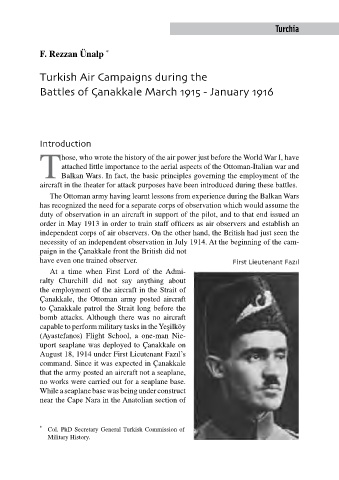
            have even one trained observer.                        First Lieutenant Fazıl
               At  a  time  when  First  Lord  of  the  Admi-
            ralty  Churchill  did  not  say  anything  about
            the employment of the aircraft in the Strait of
            Çanakkale,  the  Ottoman  army  posted  aircraft
            to Çanakkale patrol the Strait long before the
            bomb attacks. Although there was no aircraft
            capable to perform military tasks in the Yeşilköy
            (Ayastefanos)  Flight  School,  a  one-man  Nie-
            uport seaplane was deployed to Çanakkale on
            August 18, 1914 under First Lieutenant Fazıl’s
            command. Since it was expected in Çanakkale
            that the army posted an aircraft not a seaplane,
            no works were carried out for a seaplane base.
            While a seaplane base was being under construct
            near the Cape Nara in the Anatolian section of


            *   Col. PhD Secretary General Turkish Commission of
               Military History.

