


Page 240 - Le Operazioni Interforze e Multinazionali nella Storia Militare - ACTA Tomo I
P. 240
240                                XXXIX Congresso della CommIssIone InternazIonale dI storIa mIlItare • CIHm

           Viribus unitis? Austria-Hungary and its Participation in the
           Peace Mission on Crete in 1897/98


           Claudia REICHL-HAM


           1. The island of Crete and international “peace-keeping missions” before 1897/98


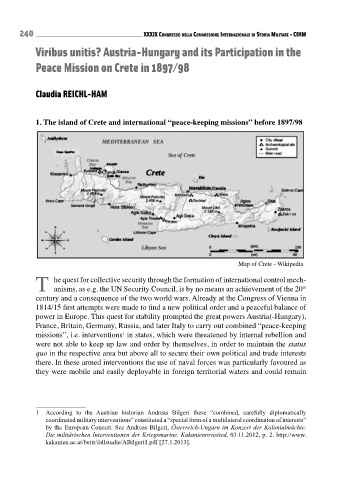
                                                                     Map of Crete - Wikipedia

                he quest for collective security through the formation of international control mech-
                                                                                       th
           T anisms, as e.g. the UN Security Council, is by no means an achievement of the 20
           century and a consequence of the two world wars. Already at the Congress of Vienna in
           1814/15 first attempts were made to find a new political order and a peaceful balance of
           power in Europe. This quest for stability prompted the great powers Austria(-Hungary),
           France, Britain, Germany, Russia, and later Italy to carry out combined “peace-keeping
           missions”, i.e. interventions  in states, which were threatened by internal rebellion and
                                    1
           were not able to keep up law and order by themselves, in order to maintain the status
           quo in the respective area but above all to secure their own political and trade interests
           there. In these armed interventions the use of naval forces was particularly favoured as
           they were mobile and easily deployable in foreign territorial waters and could remain


           1  According  to  the  Austrian  historian  Andreas  Bilgeri  these  “combined,  carefully  diplomatically
              coordinated military interventions” constituted a “special form of a multilateral coordination of interests”
              by the European Concert. See Andreas Bilgeri, Österreich-Ungarn im Konzert der Kolonialmächte.
              Die militärischen Interventionen der Kriegsmarine. Kakanienrevisited, 03.11.2012, p. 2. http://www.
              kakanien.ac.at/beitr/fallstudie/ABilgeri1.pdf [27.1.2013].

