


Page 255 - Conflitti Militari e Popolazioni Civili - Tomo II
P. 255
757
          aCta
          was also observed in other Misericórdia’s hospitals . However, this doesn’t mean that medi-
                                                     6
          cal assistance was totally denied to civilians, it just wasn’t enough.
             In addition to being a disturbing element to the normal function of the Misericórdia’s
          hospitals, the soldiers were also a heavy financially burden, which reduced the possibility to
          provide free medical assistance to civilians, especially the poor, which were more affected
          by the conflicts.

          soLdiers hospitaLized during the peninsuLar wars (1807-1811)
             although Portugal tried to remain neutral in the conflict that opposed France to england,
          a French army invaded the country at the end of November of 1807. In June of 1808, various
          regions of northern Portugal, including Vila Real where, as we said, the Divina Providência
          Hospital was located, rebelled against the French invader. later, in august, the French were
          defeated and driven out the country.
             In 1809 the French army invaded the Portuguese territory once more. It was a very brief
          military occupation that only lasted three months: March to May. The northern part of the
          country was one of the more affected regions, and Vila Real, our case study, was actually
          occupied by French troops.
             The third and last invasion occurred in June of 1810. This time, it would last till March of
          1811, when the French army fled the country.
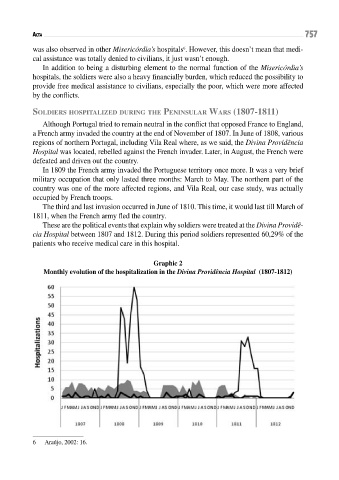
             These are the political events that explain why soldiers were treated at the Divina Providê-
          cia Hospital between 1807 and 1812. During this period soldiers represented 60,29% of the
          patients who receive medical care in this hospital.


                                             Graphic 2
             Monthly evolution of the hospitalization in the Divina Providência Hospital  (1807-1812)


          6   araújo, 2002: 16.

