


Page 254 - Conflitti Militari e Popolazioni Civili - Tomo II
P. 254
756                                XXXIV Congresso della CommIssIone InternazIonale dI storIa mIlItare • CIHm

           they were, where they were from, which company they belonged to, from which illness they
           suffered, etc.
              In this paper we will draw our attention to the evolution of the soldier’s presence in the
           Divina Providência hospital, so we can evaluate the impact of militaries’ admission to the
           hospital as an institution and to the civilians.


           the hospitaLized soLdiers
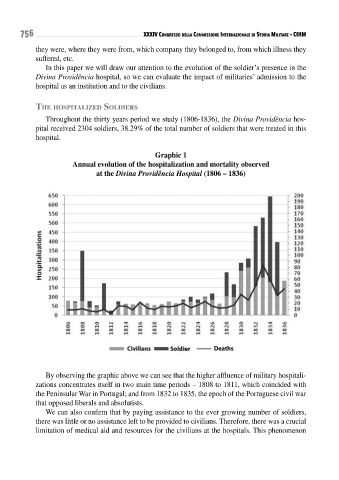
              Throughout the thirty years period we study (1806-1836), the Divina Providência hos-
           pital received 2304 soldiers, 38.29% of the total number of soldiers that were treated in this
           hospital.

                                             Graphic 1
                      Annual evolution of the hospitalization and mortality observed
                            at the Divina Providência Hospital (1806 – 1836)


              By observing the graphic above we can see that the higher affluence of military hospitali-
           zations concentrates itself in two main time periods – 1808 to 1811, which coincided with
           the Peninsular War in Portugal; and from 1832 to 1835, the epoch of the Portuguese civil war
           that opposed liberals and absolutists.
              We can also confirm that by paying assistance to the ever growing number of soldiers,
           there was little or no assistance left to be provided to civilians. Therefore, there was a crucial
           limitation of medical aid and resources for the civilians at the hospitals. This phenomenon

