


Page 161 - The Secret War in the Italian front in WWI (1915-1918)
P. 161
CHAPTER EIGHT


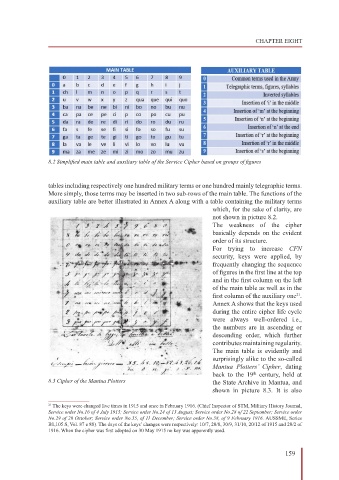
                  8.2 Simplified main table and auxiliary table of the Service Cipher based on groups of figures


                  tables including respectively one hundred military terms or one hundred mainly telegraphic terms.
                  More simply, those terms may be inserted in two sub-rows of the main table. The functions of the
                  auxiliary table are better illustrated in Annex A along with a table containing the military terms
                                                                            which, for the sake of clarity, are
                                                                            not shown in picture 8.2.
                                                                            The  weakness of the  cipher
                                                                            basically  depends on the  evident
                                                                            order of its structure.
                                                                            For trying to increase  CFN
                                                                            security, keys were applied, by
                                                                            frequently changing the sequence
                                                                            of figures in the first line at the top
                                                                            and in the first column on the left
                                                                            of the main table as well as in the
                                                                            first column of the auxiliary one .
                                                                                                         21
                                                                            Annex A shows that the keys used
                                                                            during the entire cipher life cycle
                                                                            were always well-ordered i.e.,
                                                                            the numbers are in ascending or
                                                                            descending order, which further
                                                                            contributes maintaining regularity.
                                                                            The  main  table  is  evidently  and
                                                                            surprisingly alike to the so-called
                                                                            Mantua  Plotters’  Cipher,  dating
                                                                            back to the 19  century, held at
                                                                                          th
                  8.3 Cipher of the Mantua Plotters                         the State Archive in Mantua, and
                                                                            shown in picture 8.3. It is also


                  21  The keys were changed five times in 1915 and once in February 1916. (Chief Inspector of STM, Military History Journal,
                  Service order No.16 of 4 July 1915; Service order No.24 of 13 August; Service order No.28 of 22 September; Service order
                  No.29 of 20 October; Service order No.35, of 11 December; Service order No.38, of 9 February 1916. AUSSME, Series
                  B1,105 S, Vol. 87 e 88). The days of the keys’ changes were respectively: 10/7, 20/8, 30/9, 31/10, 20/12 of 1915 and 20/2 of
                  1916. When the cipher was first adopted on 30 May 1915 no key was apparently used.


                                                                                                     159

