


Page 158 - The Secret War in the Italian front in WWI (1915-1918)
P. 158
THE SECRET WAR ON THE ITALIAN FRONT IN WWI (1915 – 1918)


              confidential correspondence between them and the President of the Council of Ministers. When
              General Porro had asked to use a special system for that kind of correspondence, the President
              of the Council of Minister Antonio Salandra sent him the FT Code, which “has never been used
              before and is not available to any other authority” .
                                                            5
              Several other codes with a different degree of dissemination, in use by the Italian army during the
              early months of the war, can be precisely listed being held by Encoding Service of the Supreme
              Command. They include the Mengarini code, the Minerva Code, the CU edited by the Ministry
              of the Interior and the K15 of the Ministry of Foreign Affairs .
                                                                      6
              The already mentioned Mengarini code - a one-part paged code - had been modified by the Army
              long before the war and its frequently used 1913 edition was often mentioned as M13 . The Austro-
                                                                                           7
              Hungarian acquisition of this commercial code helped them in decrypting messages, although in
              some cases skilful over-encoding made analysts’ work long and complex.
                                                    Even if the use of commercial codes to protect military
                                                    radio dispatches must be severely censured, yet it exists
                                                    at least an example of such codes, adapted to military
                                                    purposes, which eventually remained unbroken during
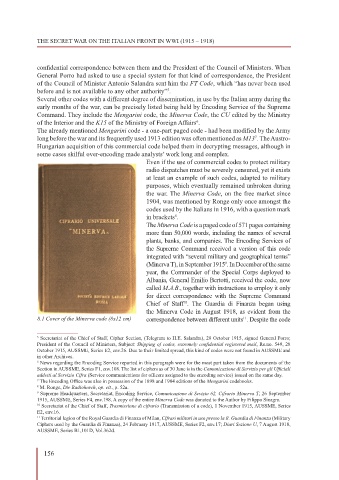
                                                    the war. The Minerva Code, on the free market since
                                                    1904, was mentioned by Ronge only once amongst the
                                                    codes used by the Italians in 1916, with a question mark
                                                    in brackets .
                                                              8
                                                    The Minerva Code is a paged code of 571 pages containing
                                                    more than 50,000 words, including the names of several
                                                    plants, banks, and companies. The Encoding Services of
                                                    the Supreme Command received a version of this code
                                                    integrated with “several military and geographical terms”
                                                    (Minerva T), in September 1915 . In December of the same
                                                                                9
                                                    year, the Commander of the Special Corps deployed to
                                                    Albania, General Emilio Bertotti, received the code, now
                                                    called M.A.B., together with instructions to employ it only
                                                    for direct correspondence with the Supreme Command
                                                    Chief of Staff .  The Guardia di Finanza began using
                                                                 10
                                                    the Minerva Code in August 1918, as evident from the
              8.1 Cover of the Minerva code (8x12 cm)  correspondence between different units . Despite the code
                                                                                      11

              5  Secretariat of the Chief of Staff, Cipher Section, (Telegram to H.E. Salandra), 28 October 1915, signed General Porro;
              President of the Council of Ministers, Subject: Shipping of codes, extremely confidential registered mail, Re.no. 549, 28
              October 1915, AUSSME, Series E2, env.26. Due to their limited spread, this kind of codes were not found in AUSSME and
              in other Archives.
              6  News regarding the Encoding Service reported in this paragraph were for the most part taken from the documents of the
              Section in AUSSME, Series F1, env.108. The list of ciphers as of 30 June is in the Comunicazione di Servizio per gli Ufficiali
              addetti al Servizio Cifra (Service communications for officers assigned to the encoding service) issued on the same day.
              7  The Encoding Office was also in possession of the 1898 and 1904 editions of the Mengarini codebooks.
              8  M. Ronge, Die Radiohorch, op. cit., p. 52a.
              9  Supreme Headquarters, Secretariat, Encoding Service, Comunicazione di Sevizio 62, Cifrario Minerva T, 26 September
              1915, AUSSME, Series F4, env.198. A copy of the entire Minerva Code was donated to the Author by Filippo Sinagra.
              10  Secretariat of the Chief of Staff, Trasmissione di cifrario (Transmission of a code), 1 November 1915, AUSSME, Series
              E2, env.16.
              11  Territorial legion of the Royal Guardia di Finanza of Milan, Cifrari militari in uso presso la R. Guardia di Finanza (Military
              Ciphers used by the Guardia di Finanza), 24 February 1917, AUSSME, Series F2, env.17; Diari Sezione U, 7 August 1918,
              AUSSME, Series B1,101D, Vol.362d.


                156

