


Page 189 - The Secret War in the Italian front in WWI (1915-1918)
P. 189
CHAPTER NINE


                  Among the possible countermeasures, the systematic substitution of the Red Code with the Blue
                  Code “which differs from the Red Code only in the page numbering” was excluded .
                                                                                               19
                  However, the letter also contains some shoddy suggestions concerning for instance to use the Green
                  Cover Code for communications between High Commands and the Pocket Military Cipher for other
                  radio dispatches. The reasons given for these choices were the larger reliability of the former because its
                  limited usage and the latter pretty secrecy due to variable keys changing every week.
                  In sum, while the diagnosis seemed correct, the recommended therapy showed evident shortcomings.
                  Relying on the Pocket Military Cipher was evidently a mistake. On the other hand, the potential
                  spread of the Green Code - limited in fact during the following months - might have compromised
                  it, if a further protection by means for instance of an effective second encoding, should had not
                  been provided.
                  Contrary to the Intelligence Office suggestion, the Red Code was suspended only temporarily,
                  probably due to the lack of an effective alternative and it reappeared on 25 April with a different
                  page numbering and an extremely simple over-coding implemented by adding fixed or periodically
                  variable numbers to the code groups.
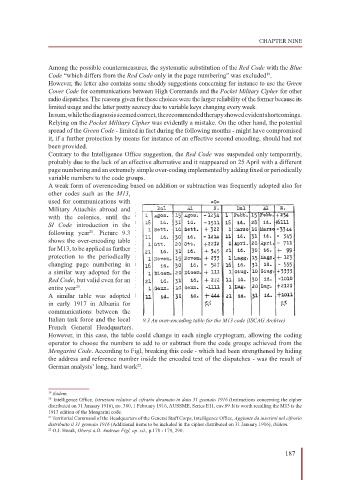
                  A weak form of overencoding based on addition or subtraction was frequently adopted also for
                  other  codes  such as the  M13,
                  used for communications with
                  Military  Attachés abroad and
                  with  the  colonies,  until  the
                  SI  Code introduction  in the
                  following year . Picture 9.3
                                20
                  shows the over-encoding table
                  for M13, to be applied as further
                  protection  to the periodically
                  changing page numbering in
                  a similar  way adopted  for the
                  Red Code, but valid even for an
                  entire year .
                            21
                  A similar  table  was adopted
                  in early 1917 in  Albania  for
                  communications  between the
                  Italian task force and the local   9.3 An over-encoding table for the M13 code (ISCAG Archive)
                  French General Headquarters.
                  However, in this case, the table could change in each single cryptogram, allowing the coding
                  operator to choose the numbers to add to or subtract from the code groups achieved from the
                  Mengarini Code. According to Figl, breaking this code - which had been strengthened by hiding
                  the address and reference number inside the encoded text of the dispatches - was the result of
                  German analysts’ long, hard work .
                                                 22


                  19  ibidem.
                  20   Intelligence Office, Istruzioni relative al cifrario diramato in data 31 gennaio 1916 (Instructions concerning the cipher
                  distributed on 31 January 1916), no. 380, 1 February 1916, AUSSME, Series E11, env.89.It is worth recalling the M13 is the

                  1913 edition of the Mengarini code.
                  21  Territorial Command of the Headquarters of the General Staff Corps, Intelligence Office, Aggiunte da inserirsi nel cifrario
                  distribuito il 31 gennaio 1916 (Additional items to be included in the cipher distributed on 31 January 1916), ibidem.
                  22  O.J. Horak, Oberst a.D. Andreas Figl, op. cit., p.178 - 179, 290.


                                                                                                     187

