


Page 203 - The Secret War in the Italian front in WWI (1915-1918)
P. 203
CHAPTER NINE


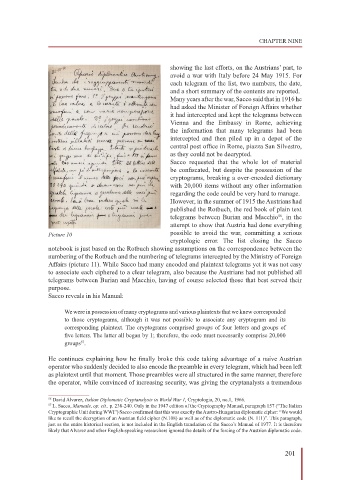
                                                             showing the last efforts, on the Austrians’ part, to
                                                             avoid a war with Italy before 24 May 1915. For
                                                             each telegram of the list, two numbers, the date,
                                                             and a short summary of the contents are reported.
                                                             Many years after the war, Sacco said that in 1916 he
                                                             had asked the Minister of Foreign Affairs whether
                                                             it had intercepted and kept the telegrams between
                                                             Vienna and the Embassy in Rome, achieving
                                                             the information that many telegrams  had been
                                                             intercepted  and  then  piled  up in  a  depot  of the
                                                             central post office in Rome, piazza San Silvestro,
                                                             as they could not be decrypted.
                                                             Sacco  requested  that  the  whole  lot  of material
                                                             be confiscated, but despite the possession of the
                                                             cryptograms, breaking a over-encoded dictionary
                                                             with 20,000 items without any other information
                                                             regarding the code could be very hard to manage.
                                                             However, in the summer of 1915 the Austrians had
                                                             published the Rotbuch, the red book of plain text
                                                             telegrams between Burian and Macchio , in the
                                                                                                   56
                                                             attempt to show that Austria had done everything
                  Picture 10                                 possible  to  avoid  the  war, committing  a  serious
                                                             cryptologic  error.  The list closing  the Sacco
                  notebook is just based on the Rotbuch showing assumptions on the correspondence between the
                  numbering of the Rotbuch and the numbering of telegrams intercepted by the Ministry of Foreign
                  Affairs (picture 11). While Sacco had many encoded and plaintext telegrams yet it was not easy
                  to associate each ciphered to a clear telegram, also because the Austrians had not published all
                  telegrams between Burian and Macchio, having of course selected those that best served their
                  purpose.
                  Sacco reveals in his Manual:

                        We were in possession of many cryptograms and various plaintexts that we knew corresponded
                        to those cryptograms, although it was not possible to associate  any cryptogram and its
                        corresponding plaintext. The cryptograms comprised groups of four letters and groups of
                        five letters. The latter all began by 1; therefore, the code must necessarily comprise 20,000
                        groups .
                             57

                  He continues explaining how he finally broke this code taking advantage of a naive Austrian
                  operator who suddenly decided to also encode the preamble in every telegram, which had been left
                  as plaintext until that moment. Those preambles were all structured in the same manner, therefore
                  the operator, while convinced of increasing security, was giving the cryptanalysts a tremendous


                  56  David Alvarez, Italian Diplomatic Cryptanalysis in World War 1, Cryptologia, 20, no.1, 1966.
                  57  L. Sacco, Manuale, op. cit., p. 238-240. Only in the 1947 edition of the Cryptography Manual, paragraph 157 (“The Italian
                  Cryptographic Unit during WWI”) Sacco confirmed that this was exactly the Austro-Hungarian diplomatic cipher: “We would
                  like to recall the decryption of an Austrian field cipher (N.108) as well as of the diplomatic code (N. 111)”. This paragraph,
                  just as the entire historical section, is not included in the English translation of the Sacco’s Manual of 1977. It is therefore
                  likely that Alvarez and other English-speaking researchers ignored the details of the forcing of the Austrian diplomatic code.


                                                                                                     201

