


Page 282 - The Secret War in the Italian front in WWI (1915-1918)
P. 282
THE SECRET WAR ON THE ITALIAN FRONT IN WWI (1915 – 1918)


              the Austrian navy, other Army Headquarters, and diplomacy had been relying on several different
              codes, including large ones, from before the war.
              The few disparches using the Carnia code a one-part book which comprised a thousand groups from 000
              to 999, had been decrypted in full. A list of about 100 entries is included in Annex B, together with one
              of the two radiograms attached to the document drafted by Section R (pictures B.5 and B.6).
              The CW code used only in November 1917 had yet not been completely broken.
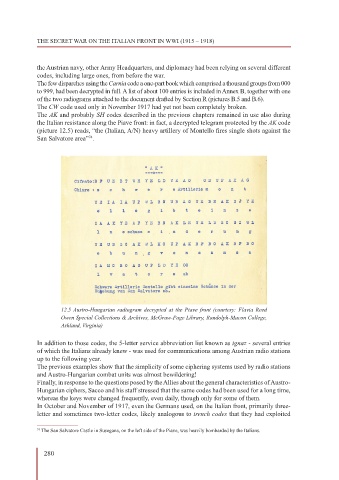
              The AK and probably SH codes described in the previous chapters remained in use also during
              the Italian resistance along the Piave front: in fact, a decrypted telegram protected by the AK code
              (picture 12.5) reads, “the (Italian, A/N) heavy artillery of Montello fires single shots against the
              San Salvatore area” .
                                74


                      12.5 Austro-Hungarian  radiogram  decrypted  at  the  Piave  front  (courtesy:  Flavia  Reed
                      Owen Special Collections & Archives, McGraw-Page Library, Randolph-Macon College,
                      Ashland, Virginia)


              In addition to those codes, the 5-letter service abbreviation list known as ignaz - several entries
              of which the Italians already knew - was used for communications among Austrian radio stations
              up to the following year.
              The previous examples show that the simplicity of some ciphering systems used by radio stations
              and Austro-Hungarian combat units was almost bewildering!
              Finally, in response to the questions posed by the Allies about the general characteristics of Austro-
              Hungarian ciphers, Sacco and his staff stressed that the same codes had been used for a long time,
              whereas the keys were changed frequently, even daily, though only for some of them.
              In October and November of 1917, even the Germans used, on the Italian front, primarily three-
              letter and sometimes two-letter codes, likely analogous to trench codes that they had exploited


              74  The San Salvatore Castle in Susegana, on the left side of the Piave, was heavily bombarded by the Italians.


                280

