


Page 209 - Airpower in 20th Century - Doctrines and Employment
P. 209
a Century of military aviation in tHe netHerlands, 1911-2011               209


            should  have  its  own
            military  air  service.  In
            its final report of April
            1912,  the  committee
            recommended  the  pur-
            chase  of  aircraft,  kite
            balloons,  observation
            balloons  and  (provi-
            sions  for)  a  motorised
            airship.  The  Minister
            of War adopted the rec-
            ommendations  in  their
            entirety  and  requested
            that  the  required  fi-
            nancial  resources  be
            allocated  in  the  1913
            Defence budget. Parlia-
            ment, however, insisted
            on   earmarking   the
            funds  exclusively  for
            aircraft, and a decision
            was made accordingly.
            The    Luchtvaartafde-
            eling  (LVA  or  Army
            Air  Arm)  was  estab-
            lished  on  1  July  1913
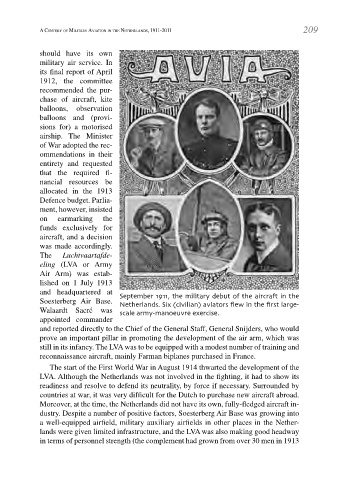
            and  headquartered  at   September 1911, the military debut of the aircraft in the
            Soesterberg  Air  Base.   Netherlands. Six (civilian) aviators flew in the first large-
            Walaardt  Sacré  was   scale army-manoeuvre exercise.
            appointed  commander
            and reported directly to the Chief of the General Staff, General Snijders, who would
            prove an important pillar in promoting the development of the air arm, which was
            still in its infancy. The LVA was to be equipped with a modest number of training and
            reconnaissance aircraft, mainly Farman biplanes purchased in France.
               The start of the First World War in August 1914 thwarted the development of the
            LVA. Although the Netherlands was not involved in the fighting, it had to show its
            readiness and resolve to defend its neutrality, by force if necessary. Surrounded by
            countries at war, it was very difficult for the Dutch to purchase new aircraft abroad.
            Moreover, at the time, the Netherlands did not have its own, fully-fledged aircraft in-
            dustry. Despite a number of positive factors, Soesterberg Air Base was growing into
            a well-equipped airfield, military auxiliary airfields in other places in the Nether-
            lands were given limited infrastructure, and the LVA was also making good headway
            in terms of personnel strength (the complement had grown from over 30 men in 1913

