


Page 283 - Airpower in 20th Century - Doctrines and Employment
P. 283
283
            tHe soutH afriCan air forCe: HistoriCal notes and involvement in tHe korean war


            The Sinuiju Raid

               The routine of the interdiction missions was broken on 9 May, when 312 aircraft
                                       st
                   th
            of the 5  Air Force and the 1  Marine Air Wing participated in Operation Buster,
            a massive raid on the 26 square km Sinuiju airfield area, which was a major North
            Korean airbase just south of the Yalu River. This and other airfields in North Korea
            had reached a stage of repair where they could be used by CCAF in an attempt to
            gain air superiority over North Korea (which would be important for a future ground
            offensive by North Korea and her allies). The neutralization of these airfields was
            thus vital and the subsequent air raid had four distinct tasks: First, top cover had to
            be provided to protect the attacking fighter-bombers from MIG-15 interference as
            Sinuiju was very close to the MIG bases in Manchuria. The second task was flak
            suppression, the third the actual bombing of the airstrip, surrounding revetments
            and supply dumps, and finally the rescue efforts (by SA-16 and SA17 flying boats)
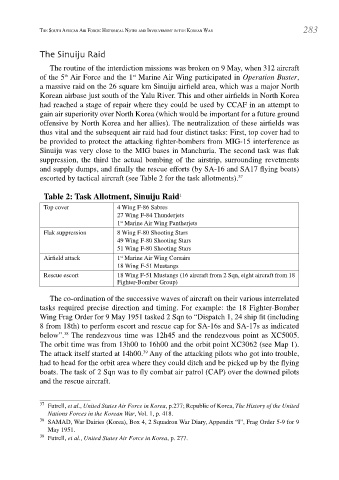
            escorted by tactical aircraft (see Table 2 for the task allotments). 37

             Table 2: Task Allotment, Sinuiju Raid  1
             Top cover            4 Wing F-86 Sabres
                                  27 Wing F-84 Thunderjets
                                   st
                                  1  Marine Air Wing Pantherjets
             Flak suppression     8 Wing F-80 Shooting Stars
                                  49 Wing F-80 Shooting Stars
                                  51 Wing F-80 Shooting Stars
                                   st
             Airfield attack      1  Marine Air Wing Corsairs
                                  18 Wing F-51 Mustangs
             Rescue escort        18 Wing F-51 Mustangs (16 aircraft from 2 Sqn, eight aircraft from 18
                                  Fighter-Bomber Group)
               The co-ordination of the successive waves of aircraft on their various interrelated
            tasks required precise direction and timing. For example: the 18 Fighter-Bomber
            Wing Frag Order for 9 May 1951 tasked 2 Sqn to “Dispatch 1, 24 ship fit (including
            8 from 18th) to perform escort and rescue cap for SA-16s and SA-17s as indicated
            below”.  The rendezvous time was 12h45 and the rendezvous point as XC5005.
                   38
            The orbit time was from 13h00 to 16h00 and the orbit point XC3062 (see Map 1).
            The attack itself started at 14h00.  Any of the attacking pilots who got into trouble,
                                          39
            had to head for the orbit area where they could ditch and be picked up by the flying
            boats. The task of 2 Sqn was to fly combat air patrol (CAP) over the downed pilots
            and the rescue aircraft.


            37
               Futrell, et al., United States Air Force in Korea, p.277; Republic of Korea, The History of the United
               Nations Forces in the Korean War, Vol. 1, p. 418.
            38
               SAMAD, War Dairies (Korea), Box 4, 2 Squadron War Diary, Appendix “I”, Frag Order 5-9 for 9
               May 1951.
            39
               Futrell, et al., United States Air Force in Korea, p. 277.

