


Page 570 - Le Operazioni Interforze e Multinazionali nella Storia Militare - ACTA Tomo I
P. 570
570                                XXXIX Congresso della CommIssIone InternazIonale dI storIa mIlItare • CIHm

                                                                th
           of Ibri), and another squadron (B ) came from Sharjah on 24  July 1957. The Force was
           given the name Carter force, and had consisted of the following: 7
           (1). Tac HQ
           (2). One Troop of Hussars of armored cars.
           (3). TOS three Squadrons
           (4). One Squadron of Sultan’s Frontier Regiment
           (5). Political & Air Contact team.


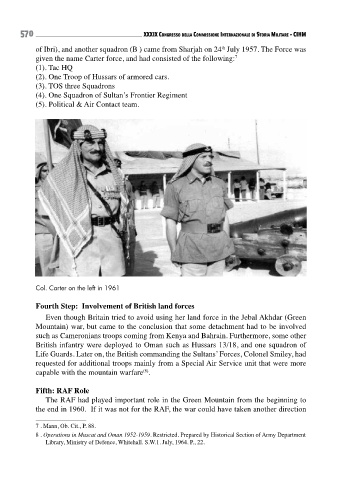
           Col. Carter on the left in 1961


           Fourth Step:  Involvement of British land forces
              Even though Britain tried to avoid using her land force in the Jebal Akhdar (Green
           Mountain) war, but came to the conclusion that some detachment had to be involved
           such as Cameronians troops coming from Kenya and Bahrain. Furthermore, some other
           British infantry were deployed to Oman such as Hussars 13/18, and one squadron of
           Life Guards. Later on, the British commanding the Sultans’ Forces, Colonel Smiley, had
           requested for additional troops mainly from a Special Air Service unit that were more
                                          (8)
           capable with the mountain warfare .

           Fifth: RAF Role
              The RAF had played important role in the Green Mountain from the beginning to
           the end in 1960.  If it was not for the RAF, the war could have taken another direction

           7 . Mann, Ob. Cit., P. 88.
           8 . Operations in Muscat and Oman 1952-1959. Restricted. Prepared by Historical Section of Army Department
              Library, Ministry of Defence, Whitehall. S.W.1. July, 1964. P., 22.

