


Page 572 - Le Operazioni Interforze e Multinazionali nella Storia Militare - ACTA Tomo I
P. 572
572                                XXXIX Congresso della CommIssIone InternazIonale dI storIa mIlItare • CIHm

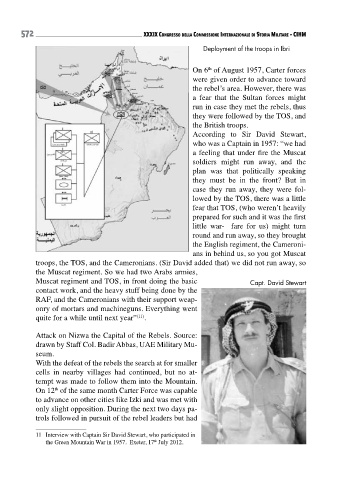
                                                           Deployment of the troops in Ibri


                                                            th
                                                        On 6  of August 1957, Carter forces
                                                        were given order to advance toward
                                                        the rebel’s area. However, there was
                                                        a fear that  the Sultan forces might
                                                        run in case they met the rebels, thus
                                                        they were followed by the TOS, and
                                                        the British troops.
                                                        According  to  Sir  David  Stewart,
                                                        who was a Captain in 1957: “we had
                                                        a feeling that under fire the Muscat
                                                        soldiers might  run away, and the
                                                        plan  was that  politically  speaking
                                                        they must be in the front? But in
                                                        case  they run away, they  were  fol-
                                                        lowed by the TOS, there was a little
                                                        fear that TOS, (who weren’t heavily
                                                        prepared for such and it was the first
                                                        little  war-   fare  for  us) might  turn
                                                        round and run away, so they brought
                                                        the English regiment, the Cameroni-
                                                        ans in behind us, so you got Muscat
           troops, the TOS, and the Cameronians. (Sir David added that) we did not run away, so
           the Muscat regiment. So we had two Arabs armies,
           Muscat regiment and TOS, in front doing the basic            Capt. David Stewart
           contact work, and the heavy stuff being done by the
           RAF, and the Cameronians with their support weap-
           onry of mortars and machineguns. Everything went
                                        (11)
           quite for a while until next year” .
           Attack on Nizwa the Capital of the Rebels. Source:
           drawn by Staff Col. Badir Abbas, UAE Military Mu-
           seum.
           With the defeat of the rebels the search at for smaller
           cells  in nearby villages  had continued,  but no at-
           tempt was made to follow them into the Mountain.
                 th
           On 12  of the same month Carter Force was capable
           to advance on other cities like Izki and was met with
           only slight opposition. During the next two days pa-
           trols followed in pursuit of the rebel leaders but had
           11  Interview with Captain Sir David Stewart, who participated in
              the Green Mountain War in 1957.  Exeter, 17  July 2012.
                                             th

