


Page 472 - Le Operazioni Interforze e Multinazionali nella Storia Militare - ACTA Tomo II
P. 472
1112                                XXXIX Congresso della CommIssIone InternazIonale dI storIa mIlItare • CIHm

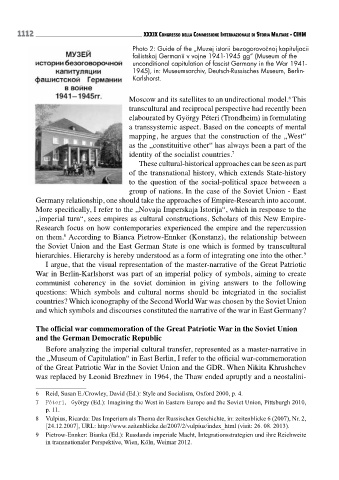
                                       Photo 2: Guide of the „Muzej istorii bezogorovočnoj kapituljacii
                                       fašistskoj Germanii v vojne 1941-1945 gg“ (Museum of the
                                       unconditional capitulation of fascist Germany in the War 1941-
                                       1945), in: Museumsarchiv, Deutsch-Russisches Museum, Berlin-
                                       Karlshorst.


                                                                                   6
                                      Moscow and its satellites to an undirectional model.  This
                                      transcultural and reciprocal perspective had recently been
                                      elabourated by György Péteri (Trondheim) in formulating
                                      a transsystemic aspect. Based on the concepts of mental
                                      mapping, he argues that the construction of the „West“
                                      as the „constituitive other“ has always been a part of the
                                      identity of the socialist countries. 7
                                         These cultural-historical approaches can be seen as part
                                      of the transnational history, which extends State-history
                                      to the question of the social-political space betweeen a
                                      group of nations. In the case of the Soviet Union - East
           Germany relationship, one should take the approaches of Empire-Research into account.
           More specifically, I refer to the „Novaja Imperskaja Istorija“, which in response to the
           „imperial turn“, sees empires as cultural constructions. Scholars of this New Empire-
           Research focus on how contemporaries experienced the empire and the repercussion
           on them.  According to Bianca Pietrow-Ennker (Konstanz), the relationship between
                   8
           the Soviet Union and the East German State is one which is formed by transcultural
                                                                                        9
           hierarchies. Hierarchy is hereby understood as a form of integrating one into the other.
              I argue, that the visual representation of the master-narrative of the Great Patriotic
           War in Berlin-Karlshorst was part of an imperial policy of symbols, aiming to create
           communist  coherency in the soviet dominion in giving answers to the following
           questions:  Which symbols and cultural  norms should be integriated  in the socialist
           countries? Which iconography of the Second World War was chosen by the Soviet Union
           and which symbols and discourses constituted the narrative of the war in East Germany?


           The official war commemoration of the Great Patriotic War in the Soviet Union
           and the German Democratic Republic
              Before analyzing the imperial cultural transfer, represented as a master-narrative in
           the „Museum of Capitulation“ in East Berlin, I refer to the official war-commemoration
           of the Great Patriotic War in the Soviet Union and the GDR. When Nikita Khrushchev
           was replaced by Leonid Brezhnev in 1964, the Thaw ended apruptly and a neostalini-

           6    Reid, Susan E./Crowley, David (Ed.): Style and Socialism, Oxford 2000, p. 4.
           7  Péteri, György (Ed.): Imagining the West in Eastern Europe and the Soviet Union, Pittsburgh 2010,
              p. 11.
           8    Vulpius, Ricarda: Das Imperium als Thema der Russischen Geschichte, in: zeitenblicke 6 (2007), Nr. 2,
              [24.12.2007], URL: http://www.zeitenblicke.de/2007/2/vulpius/index_html (visit: 26. 08. 2013).
           9    Pietrow-Ennker: Bianka (Ed.): Russlands imperiale Macht, Integrationsstrategien und ihre Reichweite
              in transnationaler Perspektive, Wien, Köln, Weimar 2012.

