


Page 477 - Le Operazioni Interforze e Multinazionali nella Storia Militare - ACTA Tomo II
P. 477
1117
          ActA
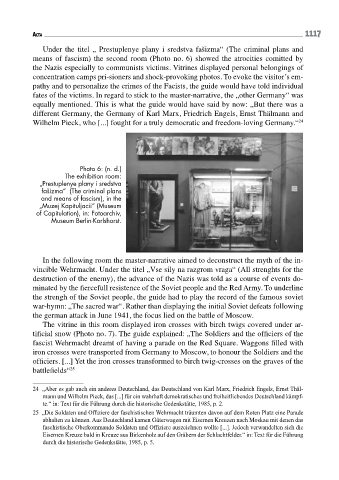
             Under the titel „ Prestuplenye plany i sredstva fašizma“ (The criminal plans and
          means of fascism) the second room (Photo no. 6) showed the atrocities comitted by
          the Nazis especially to communists victims. Vitrines displayed personal belongings of
          concentration camps pri-sioners and shock-provoking photos. To evoke the visitor’s em-
          pathy and to personalize the crimes of the Facists, the guide would have told individual
          fates of the victims. In regard to stick to the master-narrative, the „other Germany“ was
          equally mentioned. This is what the guide would have said by now: „But there was a
          different Germany, the Germany of Karl Marx, Friedrich Engels, Ernst Thälmann and
          Wilhelm Pieck, who [...] fought for a truly democratic and freedom-loving Germany.“ 24


                        Photo 6: (n. d.)
                    The exhibition room:
            „Prestuplenye plany i sredstva
             fašizma“  (The criminal plans
             and means of fascism), in the
            „Muzej Kapituljacii“ (Museum
           of Capitulation), in: Fotoarchiv,
                Museum Berlin-Karlshorst.


             In the following room the master-narrative aimed to deconstruct the myth of the in-
          vincible Wehrmacht. Under the titel „Vse sily na razgrom vraga“ (All strenghts for the
          destruction of the enemy), the advance of the Nazis was told as a course of events do-
          minated by the fiercefull resistence of the Soviet people and the Red Army. To underline
          the strengh of the Soviet people, the guide had to play the record of the famous soviet
          war-hymn: „The sacred war“. Rather than displaying the initial Soviet defeats following
          the german attack in June 1941, the focus lied on the battle of Moscow.
             The vitrine in this room displayed iron crosses with birch twigs covered under ar-
          tificial snow (Photo no. 7). The guide explained: „The Soldiers and the officiers of the
          fascist Wehrmacht dreamt of having a parade on the Red Square. Waggons filled with
          iron crosses were transported from Germany to Moscow, to honour the Soldiers and the
          officiers. [...] Yet the iron crosses transformed to birch twig-crosses on the graves of the
          battlefields“
                     25
          24  „Aber es gab auch ein anderes Deutschland, das Deutschland von Karl Marx, Friedrich Engels, Ernst Thäl-
             mann und Wilhelm Pieck, das [...] für ein wahrhaft demokratisches und freiheitliebendes Deutschland kämpf-
             te.“ in: Text für die Führung durch die historische Gedenkstätte, 1985, p. 2.
          25  „Die Soldaten und Offiziere der faschistischen Wehrmacht träumten davon auf dem Roten Platz eine Parade
             abhalten zu können. Aus Deutschland kamen Güterwagen mit Eisernen Kreuzen nach Moskau mit denen das
             faschistische Oberkommando Soldaten und Offiziere auszeichnen wollte [...]. Jedoch verwandelten sich die
             Eisernen Kreuze bald in Kreuze aus Birkenholz auf den Gräbern der Schlachtfelder.“ in: Text für die Führung
             durch die historische Gedenkstätte, 1985, p. 5.

