


Page 479 - Le Operazioni Interforze e Multinazionali nella Storia Militare - ACTA Tomo II
P. 479
1119
          ActA


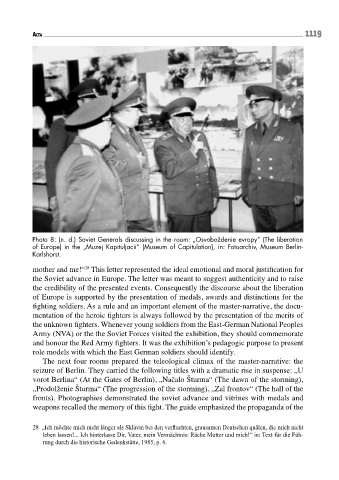
          Photo 8: (n. d.) Soviet Generals discussing in the room: „Osvoboždenie evropy“ (The liberation
          of Europe) in the „Muzej Kapituljacii“ (Museum of Capitulation), in: Fotoarchiv, Museum Berlin-
          Karlshorst.

                         28
          mother and me!“  This letter represented the ideal emotional and moral justification for
          the Soviet advance in Europe. The letter was meant to suggest authenticity and to raise
          the credibility of the presented events. Consequently the discourse about the liberation
          of Europe is supported by the presentation of medals, awards and distinctions for the
          fighting soldiers. As a rule and an important element of the master-narrative, the docu-
          mentation of the heroic fighters is always followed by the presentation of the merits of
          the unknown fighters. Whenever young soldiers from the East-German National Peoples
          Army (NVA) or the the Soviet Forces visited the exhibition, they should commemorate
          and honour the Red Army fighters. It was the exhibition’s pedagogic purpose to present
          role models with which the East German soldiers should identify.
             The next four rooms prepared the teleological climax of the master-narrative: the
          seizure of Berlin. They carried the following titles with a dramatic rise in suspense: „U
          vorot Berlina“ (At the Gates of Berlin), „Načalo Šturma“ (The dawn of the storming),
          „Prodolženie Šturma“ (The progression of the storming), „Zal frontov“ (The hall of the
          fronts). Photographies demonstrated the soviet advance and vitrines with medals and
          weapons recalled the memory of this fight. The guide emphasized the propaganda of the

          28  „Ich möchte mich nicht länger als Sklavin bei den verfluchten, grausamen Deutschen quälen, die mich nicht
             leben lassen!... Ich hinterlasse Dir, Vater, mein Vermächtnis: Räche Mutter und mich!“ in: Text für die Füh-
             rung durch die historische Gedenkstätte, 1985, p. 6.

