


Page 476 - Le Operazioni Interforze e Multinazionali nella Storia Militare - ACTA Tomo II
P. 476
1116                                XXXIX Congresso della CommIssIone InternazIonale dI storIa mIlItare • CIHm

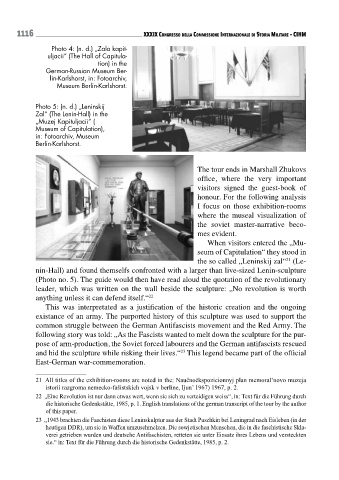
                Photo 4: (n. d.) „Zala kapit-
               uljacii“ (The Hall of Capitula-
                             tion) in the
              German-Russian Museum Ber-
               lin-Karlshorst, in: Fotoarchiv,
                 Museum Berlin-Karlshorst.


           Photo 5: (n. d.) „Leninskij
           Zal“ (The Lenin-Hall) in the
           „Muzej Kapituljacii“ (
           Museum of Capitulation),
           in: Fotoarchiv, Museum
           Berlin-Karlshorst.


                                                         The tour ends in Marshall Zhukovs
                                                         office,  where  the  very  important
                                                         visitors signed the guest-book of
                                                         honour. For the following analysis
                                                         I focus on those exhibition-rooms
                                                         where the museal  visualization of
                                                         the soviet master-narrative  beco-
                                                         mes evident.
                                                            When visitors entered the „Mu-
                                                         seum of Capitulation“ they stood in
                                                                                  21
                                                         the so called „Leninskij zal“  (Le-
           nin-Hall) and found themselfs confronted with a larger than live-sized Lenin-sculpture
           (Photo no. 5). The guide would then have read aloud the quotation of the revolutionary
           leader, which was written on the wall beside the sculpture: „No revolution is worth
           anything unless it can defend itself.“ 22
              This  was  interpretated  as  a  justification  of  the  historic  creation  and  the  ongoing
           existance of an army. The purported history of this sculpture was used to support the
           common struggle between the German Antifascists movement and the Red Army. The
           following story was told: „As the Fascists wanted to melt down the sculpture for the pur-
           pose of arm-production, the Soviet forced labourers and the German antifascists rescued
           and hid the sculpture while risking their lives.“  This legend became part of the official
                                                    23
           East-German war-commemoration.
           21  All titles of the exhibition-rooms are noted in the: Naučnoėkspozicionnyj plan memoral’novo muzeja
              istorii razgroma nemecko-fašistskich vojsk v berline, Ijun’ 1967) 1967, p. 2.
           22  „Eine Revolution ist nur dann etwas wert, wenn sie sich zu verteidigen weiss“, in: Text für die Führung durch
              die historische Gedenkstätte, 1985, p. 1. English translations of the german transcript of the tour by the author
              of this paper.
           23  „1943 brachten die Faschisten diese Leninskulptur aus der Stadt Puschkin bei Leningrad nach Eisleben (in der
              heutigen DDR), um sie in Waffen umzuschmelzen. Die sowjetischen Menschen, die in die faschistische Skla-
              verei getrieben wurden und deutsche Antifaschisten, retteten sie unter Einsatz ihres Lebens und versteckten
              sie.“ in: Text für die Führung durch die historische Gedenkstätte, 1985, p. 2.

