


Page 473 - Le Operazioni Interforze e Multinazionali nella Storia Militare - ACTA Tomo II
P. 473
1113
          ActA
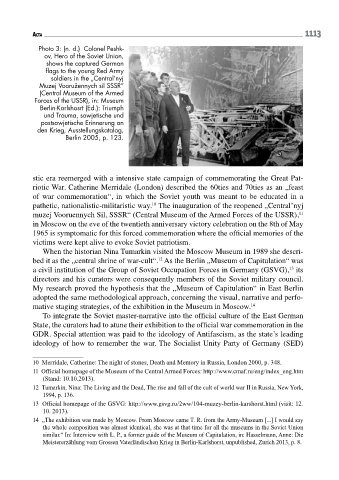
            Photo 3: (n. d.)  Colonel Peshk-
              ov, Hero of the Soviet Union,
              shows the captured German
              flags to the young Red Army
                soldiers in the „Central‘nyj
            Muzej Vooružennych sil SSSR“
            (Central Museum of the Armed
           Forces of the USSR), in: Museum
            Berlin-Karlshosrt (Ed.): Triumph
              und Trauma, sowjetische und
             postsowjetische Erinnerung an
            den Krieg, Ausstellungskatalog,
                    Berlin 2005, p. 123.


          stic era reemerged with a intensive state campaign of commemorating the Great Pat-
          riotic War. Catherine Merridale (London) described the 60ties and 70ties as an „feast
          of war commemoration“, in which the Soviet youth was meant to be educated in a
                                            10
          pathetic, nationalistic-militaristic way.  The inauguration of the reopened „Central’nyj
                                                                                      11
          muzej Vooruennych Sil, SSSR“ (Central Museum of the Armed Forces of the USSR),
          in Moscow on the eve of the twentieth anniversary victory celebration on the 8th of May
          1965 is symptomatic for this forced commemoration where the official memories of the
          victims were kept alive to evoke Soviet patriotism.
             When the historian Nina Tumarkin visited the Moscow Museum in 1989 she descri-
                                              12
          bed it as the „central shrine of war-cult“.  As the Berlin „Museum of Capitulation“ was
                                                                                   13
          a civil institution of the Group of Soviet Occupation Forces in Germany (GSVG),  its
          directors and his curators were consequently members of the Soviet military council.
          My research proved the hypothesis that the „Museum of Capitulation“ in East Berlin
          adopted the same methodological approach, concerning the visual, narrative and perfo-
                                                                        14
          mative staging strategies, of the exhibition in the Museum in Moscow.
             To integrate the Soviet master-narrative into the official culture of the East German
          State, the curators had to atune their exhibition to the official war commemoration in the
          GDR. Special attention was paid to the ideology of Antifascism, as the state’s leading
          ideology of how to remember the war. The Socialist Unity Party of Germany (SED)

          10  Merridale, Catherine: The night of stones, Death and Memory in Russia, London 2000, p. 348.
          11  Official homepage of the Museum of the Central Armed Forces: http://www.cmaf.ru/eng/index_eng.htm
             (Stand: 10.10.2013).
          12  Tumarkin, Nina: The Living and the Dead, The rise and fall of the cult of world war II in Russia, New York,
             1994, p. 136.
          13  Official homepage of the GSVG: http://www.gsvg.ru/2ww/104-muzey-berlin-karshorst.html (visit: 12.
             10. 2013).
          14  „The exhibition was made by Moscow. From Moscow came T. R. from the Army-Museum [...] I would say
             the whole composition was almost identical, she was at that time for all the museums in the Soviet Union
             similar.“ In: Interview with L. P., a former guide of the Museum of Capitulation, in: Hasselmann, Anne: Die
             Meistererzählung vom Grossen Vaterländischen Krieg in Berlin-Karlshorst, unpublished, Zurich 2013, p. 8.

