


Page 480 - Le Operazioni Interforze e Multinazionali nella Storia Militare - ACTA Tomo II
P. 480
1120                                XXXIX Congresso della CommIssIone InternazIonale dI storIa mIlItare • CIHm

                                                       humanitarian and caring Red Army:
                                                       „The supreme command of the Red
                                                       Army intended to preserve the Ger-
                                                       man Nation and to blow the fascist
                                                       beast in its cave [...]“ . To  support
                                                                           29
                                                       this claim  a three-dimensional  mo-
                                                       dell  of Berlin  was exhibted. Follo-
                                                       wing the  guide  Marshall  Zhukov
                                                       ordered it’s fabrication on the eve of
                                                       the storming; it shows all the 600‘000
                                                       houses which weren’t destroyed prior
                                                       to the start of the Berlin-Operation. 30
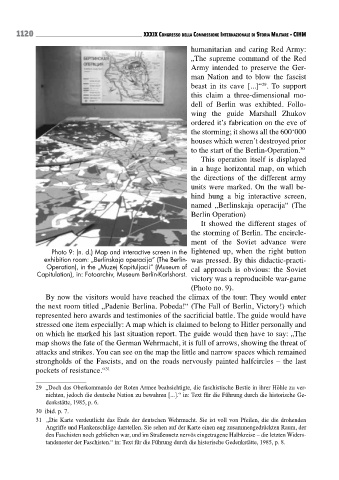
                                                          This operation itself is displayed
                                                       in a huge horizontal map, on which
                                                       the directions  of the different army
                                                       units were marked. On the wall be-
                                                       hind hung a big interactive  screen,
                                                       named  „Berlinskaja operacija“ (The
                                                       Berlin Operation)
                                                          It showed the different stages of
                                                       the storming of Berlin. The encircle-
                                                       ment of the Soviet advance were
                Photo 9: (n. d.) Map and interactive screen in the   lightened  up, when the right button
              exhibition room: „Berlinskaja operacija“ (The Berlin-  was pressed. By this didactic-practi-
              Operation), in the „Muzej Kapituljacii“ (Museum of   cal approach is obvious: the Soviet
            Capitulation), in: Fotoarchiv, Museum Berlin-Karlshorst.
                                                       victory was a reproducible war-game
                                                       (Photo no. 9).
              By now the visitors would have reached the climax of the tour: They would enter
           the next room titled „Padenie Berlina. Pobeda!“ (The Fall of Berlin, Victory!) which
           represented hero awards and testimonies of the sacrificial battle. The guide would have
           stressed one item especially: A map which is claimed to belong to Hitler personally and
           on which he marked his last situation report. The guide would then have to say: „The
           map shows the fate of the German Wehrmacht, it is full of arrows, showing the threat of
           attacks and strikes. You can see on the map the little and narrow spaces which remained
           strongholds of the Fascists, and on the roads nervously painted halfcircles – the last
           pockets of resistance.“ 31

           29  „Doch das Oberkommando der Roten Armee beabsichtigte, die faschistische Bestie in ihrer Höhle zu ver-
              nichten, jedoch die deutsche Nation zu bewahren [...].“ in: Text für die Führung durch die historische Ge-
              denkstätte, 1985, p. 6.
           30  ibid. p. 7.
           31  „Die Karte verdeutlicht das Ende der deutschen Wehrmacht. Sie ist voll von Pfeilen, die die drohenden
              Angriffe und Flankenschläge darstellen. Sie sehen auf der Karte einen eng zusammengedrückten Raum, der
              den Faschisten noch geblieben war, und im Straßennetz nervös eingetragene Halbkreise – die letzten Widers-
              tandsnester der Faschisten.“ in: Text für die Führung durch die historische Gedenkstätte, 1985, p. 8.

