


Page 504 - Le Operazioni Interforze e Multinazionali nella Storia Militare - ACTA Tomo II
P. 504
1144                                XXXIX Congresso della CommIssIone InternazIonale dI storIa mIlItare • CIHm

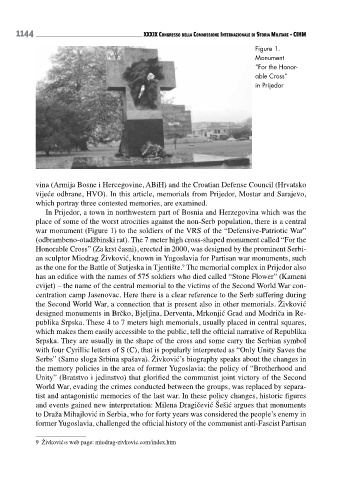
                                                                          Figure 1.
                                                                          Monument
                                                                          “For the Honor-
                                                                          able Cross”
                                                                          in Prijedor


           vina (Armija Bosne i Hercegovine, ABiH) and the Croatian Defense Council (Hrvatsko
           vijeće odbrane, HVO). In this article, memorials from Prijedor, Mostar and Sarajevo,
           which portray three contested memories, are examined.
              In Prijedor, a town in northwestern part of Bosnia and Herzegovina which was the
           place of some of the worst atrocities against the non-Serb population, there is a central
           war monument (Figure 1) to the soldiers of the VRS of the “Defensive-Patriotic War”
           (odbrambeno-otadžbinski rat). The 7 meter high cross-shaped monument called “For the
           Honorable Cross” (Za krst časni), erected in 2000, was designed by the prominent Serbi-
           an sculptor Miodrag Živković, known in Yugoslavia for Partisan war monuments, such
           as the one for the Battle of Sutjeska in Tjentište.  The memorial complex in Prijedor also
                                                     9
           has an edifice with the names of 575 soldiers who died called “Stone Flower” (Kameni
           cvijet) – the name of the central memorial to the victims of the Second World War con-
           centration camp Jasenovac. Here there is a clear reference to the Serb suffering during
           the Second World War, a connection that is present also in other memorials. Živković
           designed monuments in Brčko, Bjeljina, Derventa, Mrkonjić Grad and Modriča in Re-
           publika Srpska. These 4 to 7 meters high memorials, usually placed in central squares,
           which makes them easily accessible to the public, tell the official narrative of Republika
           Srpska. They are usually in the shape of the cross and some carry the Serbian symbol
           with four Cyrillic letters of S (C), that is popularly interpreted as “Only Unity Saves the
           Serbs” (Samo sloga Srbina spašava). Živković’s biography speaks about the changes in
           the memory policies in the area of former Yugoslavia: the policy of “Brotherhood and
           Unity” (Bratstvo i jedinstvo) that glorified the communist joint victory of the Second
           World War, evading the crimes conducted between the groups, was replaced by separa-
           tist and antagonistic memories of the last war. In these policy changes, historic figures
           and events gained new interpretation: Milena Dragičević Šešić argues that monuments
           to Draža Mihajlović in Serbia, who for forty years was considered the people’s enemy in
           former Yugoslavia, challenged the official history of the communist anti-Fascist Partisan


           9  Živković›s web page: miodrag-zivkovic.com/index.htm

