


Page 507 - Le Operazioni Interforze e Multinazionali nella Storia Militare - ACTA Tomo II
P. 507
1147
          ActA
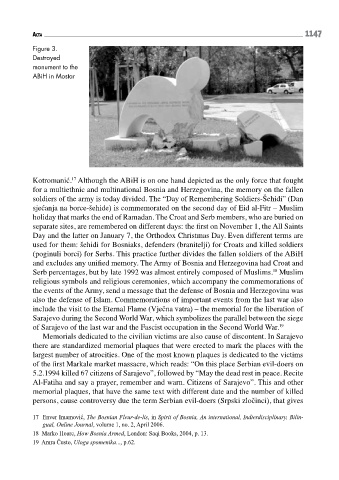
          Figure 3.
          Destroyed
          monument to the
          ABiH in Mostar


                     17
          Kotromanić.  Although the ABiH is on one hand depicted as the only force that fought
          for a multiethnic and multinational Bosnia and Herzegovina, the memory on the fallen
          soldiers of the army is today divided. The “Day of Remembering Soldiers-Šehidi” (Dan
          sjećanja na borce-šehide) is commemorated on the second day of Eid al-Fitr – Muslim
          holiday that marks the end of Ramadan. The Croat and Serb members, who are buried on
          separate sites, are remembered on different days: the first on November 1, the All Saints
          Day and the latter on January 7, the Orthodox Christmas Day. Even different terms are
          used for them: šehidi for Bosniaks, defenders (branitelji) for Croats and killed soldiers
          (poginuli borci) for Serbs. This practice further divides the fallen soldiers of the ABiH
          and excludes any unified memory. The Army of Bosnia and Herzegovina had Croat and
                                                                               18
          Serb percentages, but by late 1992 was almost entirely composed of Muslims.  Muslim
          religious symbols and religious ceremonies, which accompany the commemorations of
          the events of the Army, send a message that the defense of Bosnia and Herzegovina was
          also the defense of Islam. Commemorations of important events from the last war also
          include the visit to the Eternal Flame (Vječna vatra) – the memorial for the liberation of
          Sarajevo during the Second World War, which symbolizes the parallel between the siege
          of Sarajevo of the last war and the Fascist occupation in the Second World War. 19
             Memorials dedicated to the civilian victims are also cause of discontent. In Sarajevo
          there are standardized memorial plaques that were erected to mark the places with the
          largest number of atrocities. One of the most known plaques is dedicated to the victims
          of the first Markale market massacre, which reads: “On this place Serbian evil-doers on
          5.2.1994 killed 67 citizens of Sarajevo”, followed by “May the dead rest in peace. Recite
          Al-Fatiha and say a prayer, remember and warn. Citizens of Sarajevo”. This and other
          memorial plaques, that have the same text with different date and the number of killed
          persons, cause controversy due the term Serbian evil-doers (Srpski zločinci), that gives

          17  Enver Imamović, The Bosnian Fleur-de-lis, in Spirit of Bosnia, An international, Indterdisciplinary, Bilin-
             gual, Online Journal, volume 1, no. 2, April 2006.
          18  Marko Hoare, How Bosnia Armed, London: Saqi Books, 2004, p. 13.
          19  Amra Čusto, Uloga spomenika..., p.62.

