


Page 510 - Le Operazioni Interforze e Multinazionali nella Storia Militare - ACTA Tomo II
P. 510
1150                                XXXIX Congresso della CommIssIone InternazIonale dI storIa mIlItare • CIHm

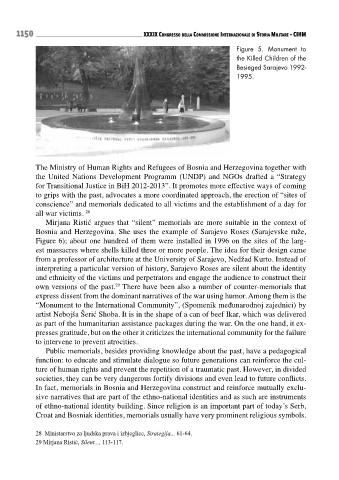
                                                                    Figure 5. Monument to
                                                                    the Killed Children of the
                                                                    Besieged Sarajevo 1992-
                                                                    1995.


           The Ministry of Human Rights and Refugees of Bosnia and Herzegovina together with
           the United Nations Development Programm (UNDP) and NGOs drafted a “Strategy
           for Transitional Justice in BiH 2012-2013”. It promotes more effective ways of coming
           to grips with the past, advocates a more coordinated approach, the erection of “sites of
           conscience” and memorials dedicated to all victims and the establishment of a day for
           all war victims.  28
              Mirjana Ristić argues that “silent” memorials are more suitable in the context of
           Bosnia and Herzegovina. She uses the example of Sarajevo Roses (Sarajevske ruže,
           Figure 6); about one hundred of them were installed in 1996 on the sites of the larg-
           est massacres where shells killed three or more people. The idea for their design came
           from a professor of architecture at the University of Sarajevo, Nedžad Kurto. Instead of
           interpreting a particular version of history, Sarajevo Roses are silent about the identity
           and ethnicity of the victims and perpetrators and engage the audience to construct their
                                  29
           own versions of the past.  There have been also a number of counter-memorials that
           express dissent from the dominant narratives of the war using humor. Among them is the
           “Monument to the International Community”, (Spomenik međunarodnoj zajednici) by
           artist Nebojša Šerić Shoba. It is in the shape of a can of beef Ikar, which was delivered
           as part of the humanitarian assistance packages during the war. On the one hand, it ex-
           presses gratitude, but on the other it criticizes the international community for the failure
           to intervene to prevent atrocities.
              Public memorials, besides providing knowledge about the past, have a pedagogical
           function: to educate and stimulate dialogue so future generations can reinforce the cul-
           ture of human rights and prevent the repetition of a traumatic past. However, in divided
           societies, they can be very dangerous fortify divisions and even lead to future conflicts.
           In fact, memorials in Bosnia and Herzegovina construct and reinforce mutually exclu-
           sive narratives that are part of the ethno-national identities and as such are instruments
           of ethno-national identity building. Since religion is an important part of today’s Serb,
           Croat and Bosniak identities, memorials usually have very prominent religious symbols.

           28  Ministarstvo za ljudska prava i izbjeglice, Strategija... 61-64.
           29 Mirjana Ristić, Silent..., 113-117.

